 By Rizwan Aslam
Quick Answer
A search engine is a software system that crawls the web, indexes billions of pages, and ranks the most relevant results when you type a query. Google, Bing, and DuckDuckGo are the most widely used examples. Understanding how they work helps you find information faster, build better websites, and avoid misinformation online.
Every day, people around the world type more than 8.5 billion queries into Google alone — that’s roughly 99,000 searches every single second, according to Internet Live Stats. Yet most of those people have no idea what happens between pressing Enter and seeing results appear.
That gap matters. Whether you’re a student trying to research smarter, a business owner wondering why your website doesn’t show up, or simply a curious person who wants to understand the internet better, knowing how search engines work gives you a genuine advantage.
This guide explains search engine basics in plain language — no jargon, no fluff. By the end, you’ll understand exactly how a search engine finds, reads, and ranks every page on the web.
What Is a Search Engine? (And Why It Matters)
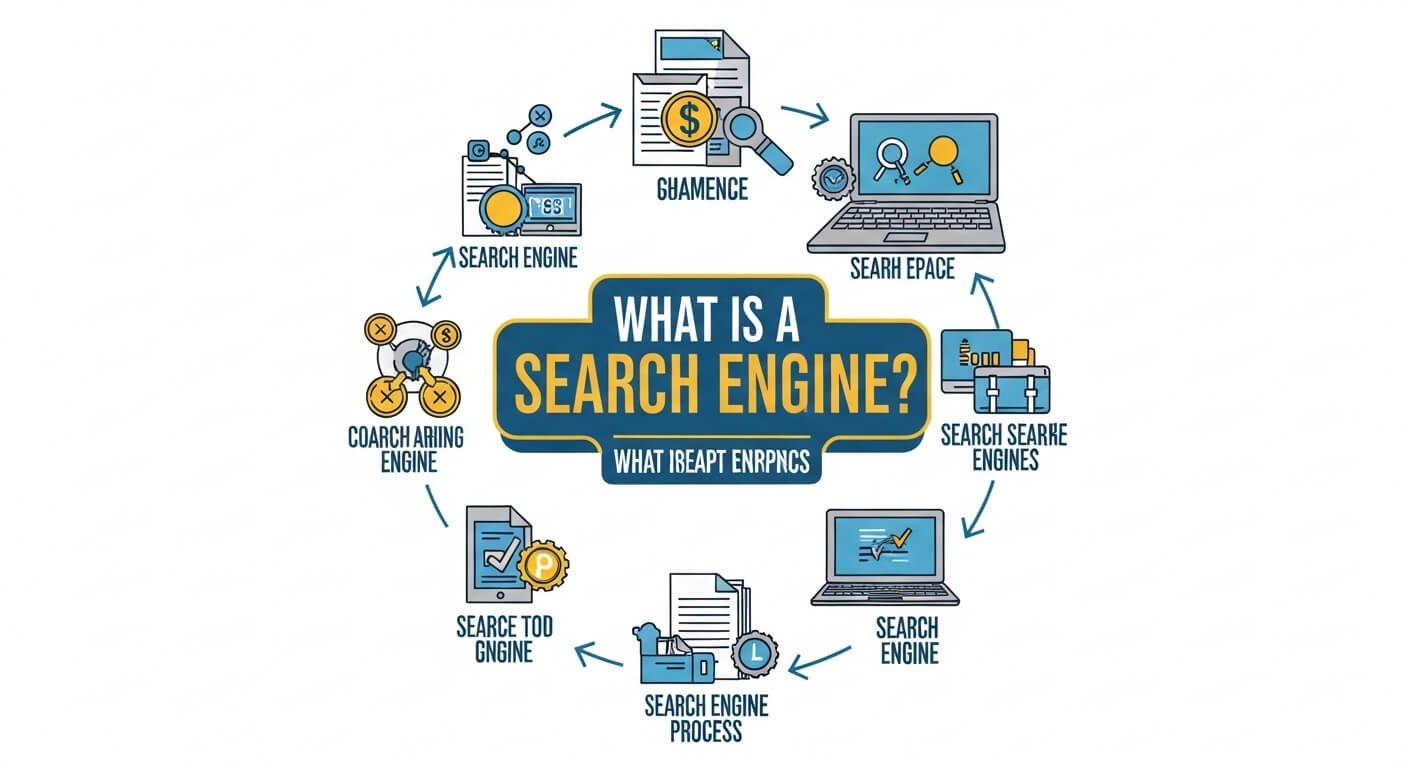
A search engine is a tool that helps you find information on the internet by matching your query to relevant web pages. Think of it as an enormous, constantly updated library catalogue — except instead of indexing books on shelves, it indexes hundreds of billions of web pages across every corner of the internet.
The term ‘search engine’ covers three distinct things working together: a web crawler that discovers content, an index that stores it, and a ranking algorithm that decides what you see first. Strip away one of those three, and the system falls apart entirely.
Search engines became commercially significant in the 1990s. Early systems like AltaVista and Yahoo Directory gave way to Google, which launched in 1998 with a radically different approach to ranking: PageRank, a system that scored pages based on how many other pages linked to them. That single idea reshaped the internet.
Why Understanding Search Engines Is Still Valuable in 2026
You might wonder: with AI assistants answering questions directly, do search engines still matter? Yes, significantly. Google’s own AI Overviews — which appear in roughly 18.76% of search results as of early 2026 according to Semrush — still pull from indexed web pages. The underlying search infrastructure hasn’t changed; only the presentation layer has.
Knowing how search engines work helps you evaluate the quality of results you’re reading, understand why certain websites rank highly, and use advanced search operators to find exactly what you need faster.
How a Search Engine Works: The 3-Step Process
Every search engine, regardless of which company built it, operates on the same three foundational steps. Here they are, explained simply.
Step 1 — Crawling: Discovering the Web
Web crawling is the process by which a search engine’s automated programs — called crawlers, spiders, or bots — browse the internet to find and read web pages. Google’s crawler is called Googlebot. Bing’s is called Bingbot.
Crawlers work by following links. They start with a list of known URLs, visit each page, read its content, and then follow every link on that page to find new pages. This chain of link-following is how they gradually discover the entire web — or as much of it as they can.
Not everything gets crawled. Pages that have no links pointing to them (so-called ‘orphan pages’), pages blocked by a robots.txt file, and pages behind login walls typically won’t be found by crawlers. This is why internal linking matters so much when building a website.
Step 2 — Indexing: Storing What Was Found
After a page is crawled, its content is processed and stored in an index — a massive database that works a bit like the index at the back of a textbook. Google’s index alone contains hundreds of billions of pages and occupies over 100 petabytes of storage, according to Google’s own documentation.
During indexing, the search engine analyses each page’s text, headings, images, structured data, and metadata. It also records signals like the page’s language, what topics it covers, how fast it loads, and whether it works well on mobile devices. All of this information shapes how the page will eventually rank.
An important nuance: being crawled doesn’t guarantee being indexed. A page may be crawled but excluded from the index if it has thin content, is a duplicate of another page, or is explicitly marked with a ‘noindex’ tag by its developer.
Step 3 — Ranking: Deciding What You See First
Ranking is where the real complexity lies. When you type a search query, the search engine doesn’t re-read the entire web in real time. It queries its pre-built index and applies a ranking algorithm to return the most relevant results in milliseconds.
Google’s ranking algorithm reportedly weighs more than 200 factors. Some of the most consistently confirmed signals include the relevance of the page’s content to your query, the quality and quantity of backlinks from other websites, the page’s load speed and mobile usability, and user engagement signals like how quickly people return to the search page after visiting (indicating the result didn’t satisfy them).
In 2026, Google’s ranking systems will also include neural-network models like BERT and MUM that understand natural language context, not just keywords. This is why a page optimized purely for keyword density tends to rank poorly compared to one that genuinely addresses a topic in depth.
The Main Components of a Search Engine
Understanding the architecture of a search engine helps demystify how all the pieces connect. Here are the core components:
1. Web Crawler
The automated bot that discovers pages. Crawlers prioritize pages based on signals like update frequency, link authority, and server response speed. Sites that publish fresh content regularly or have many links pointing to them tend to get crawled more frequently.
2. URL Frontier
A queue of URLs waiting to be crawled. The URL frontier manages the order and priority in which pages are visited, balancing thoroughness with efficiency. High-priority pages (news articles, authoritative domains) are processed faster.
3. Document Store / Repository
The raw storage of crawled page content before it’s fully processed. Think of it as a temporary holding area before pages are moved into the searchable index.
4. Indexer
The system that processes crawled pages and builds the inverted index — a data structure that maps every word to every page it appears on. Inverted indexes are the reason search engines can find relevant pages in milliseconds despite having billions of documents to search through.
5. Query Processor
The component that handles your search query in real time. It parses your input, expands it with semantic understanding (so searching ‘car’ also considers ‘vehicle’ and ‘automobile’), and retrieves candidate results from the index.
6. Ranking Engine
The algorithm that scores and orders results. This is where signals like PageRank, content quality, user experience metrics, and E-E-A-T (Experience, Expertise, Authoritativeness, Trustworthiness) factors all come into play.
Types of Search Engines: Not All Work the Same Way
| Type | How It Works | Examples |
| Crawler-based | Uses bots to crawl and index the web automatically | Google, Bing, Yahoo |
| Human-curated Directory | Editors manually categorize websites | DMOZ (now closed), early Yahoo |
| Meta Search Engine | Queries multiple engines and combines results | Startpage, Dogpile |
| Vertical / Niche Search | Indexes a specific type of content only | YouTube (video), PubMed (medical) |
| Privacy-focused | Crawler-based but without tracking or personalization | DuckDuckGo, Brave Search |
| Enterprise Search | Indexes internal documents and company data | Elasticsearch, Microsoft Search |
Most people use crawler-based search engines for everyday queries. However, vertical search engines often produce better results for highly specialized needs — PubMed for medical research, Google Scholar for academic papers, or Zillow for property listings.
How Search Engines Work: Step-by-Step Diagram
Visualizing the search process helps make it concrete. Here’s a simplified flow of what happens from the moment a website goes live to the moment it appears in your search results:
-
- A new page is published on the web with a URL.
- Another site links to it, or the owner submits the URL via Google Search Console.
- Googlebot discovers the URL and adds it to the crawl queue.
- The crawler visits the page, reads its HTML, and follows its links.
- The page’s content, metadata, and signals are extracted and stored.
- The indexer processes the page and adds it to the inverted index.
- A user types a query matching the page’s topic.
- The query processor retrieves candidate results from the index.
- The ranking engine scores each result based on hundreds of signals.
- The top-ranked results appear on the search engine results page (SERP) within milliseconds.
This entire process, from indexing to returning results, takes an average of around 0.5 seconds for most queries, according to Google’s developer documentation. The crawling phase that makes it possible, however, can take days or even weeks for newer or less-linked pages.
Search Engine Optimization Basics: What You Can Actually Control
Search engine optimization (SEO) is the practice of improving a page so it ranks higher in organic search results. It’s worth understanding even if you never build a website, because it explains why certain results appear before others.
On-Page SEO Fundamentals
On-page SEO refers to factors within the page itself. The most important of these is content relevance: does the page genuinely address what the user is searching for? Pages that match search intent closely — not just the keywords, but the underlying need — consistently outperform those that merely repeat a phrase many times.
Other on-page signals include title tags (the clickable headline in search results), meta descriptions (the summary below the headline), heading structure, image alt text, and internal links connecting related pages on the same site.
Technical SEO: The Foundation
Technical SEO covers the infrastructure that makes a page accessible and understandable to search engines. Core Web Vitals — a set of metrics Google uses to assess user experience — include Largest Contentful Paint (how quickly the main content loads), Interaction to Next Paint (how responsive the page is to clicks), and Cumulative Layout Shift (how much the page moves around as it loads).
A site that loads slowly, doesn’t work on mobile, or has broken links signals poor quality to search engines. These technical problems can suppress rankings even when the content itself is excellent.
Off-Page SEO: Building Authority
Off-page SEO primarily means earning backlinks — links from other websites to yours. A link from a trusted, authoritative site acts as a vote of confidence. The more high-quality sites link to a page, the more authoritative that page appears to search engines.
The keyword is ‘earned.’ Buying links, participating in link schemes, or artificially inflating your backlink profile can lead to manual penalties from Google. Sustainable SEO means creating content valuable enough that other sites link to it naturally.
How to Do a Basic Search on a Search Engine: Tips That Actually Work
Most people use search engines the same way they’ve always done: type a few words, scroll the first page, and click something. But search engines understand far more nuanced inputs than most people realize.
Use Quotation Marks for Exact Phrases
Typing “climate change effects on coral reefs” (with quotation marks) tells the search engine to only return pages containing that exact phrase in that exact order. This is useful when you’re looking for a specific quote, study title, or phrase.
Use the Minus Sign to Exclude Terms
If you search for jaguar -car, you’ll get results about the animal, not the automobile. The minus sign tells the engine to exclude any result containing that word.
What Does * Mean When Searching?
The asterisk (*) works as a wildcard in search. Typing “the * of the United States” will return results filling in the blank with any word — ‘President,’ ‘history,’ ‘capital,’ and so on. It’s especially useful when you remember part of a phrase but not the exact wording.
What Is an A* Search? (For the Technically Curious)
A* (pronounced ‘A-star’) is a search algorithm used in computer science and artificial intelligence — not a web search engine feature. It’s a pathfinding algorithm that finds the shortest route between two points by estimating costs intelligently. If you’ve seen GPS navigation or video game character pathfinding, you’ve seen A* in action. It’s separate from the web search context but comes up frequently in search engine optimization research and technical discussions.
Search Engine Examples: The Major Players in 2026
| Search Engine | Market Share (2025) | Key Differentiator |
| ~91.5% | Largest index, AI Overviews, Knowledge Graph | |
| Microsoft Bing | ~3.9% | Integrated with Microsoft 365, Copilot AI |
| Yahoo Search | ~1.1% | Powered by Bing, an older demographic |
| DuckDuckGo | ~0.6% | No personal data tracking or profiling |
| Brave Search | ~0.2% | Independent index, privacy-first, no Big Tech dependency |
| Yandex | Dominant in Russia | Strong language support for Slavic languages |
| Baidu | Dominant in China | Largest Chinese-language index and AI models |
Market share figures are approximate based on StatCounter Global Stats data for late 2025. Google’s dominance — holding over 90% of global search traffic — means that most SEO strategies focus primarily on ranking in Google’s index, though businesses with regional focus in Russia or China must optimize for Yandex or Baidu, respectively.
Search Engine Algorithm Basics: How Ranking Decisions Are Made
A search engine algorithm is a set of rules and calculations that determines the order of search results. Google doesn’t publish its algorithm, but years of research, testing, and official documentation have revealed its most important components.
PageRank: The Original Foundation
Larry Page and Sergey Brin developed PageRank while at Stanford University in 1996. The core idea: a page is important if important pages link to it. PageRank scores flow from one page to another through links — a bit like votes, where a vote from an authoritative site counts for more.
PageRank is still a ranking signal, but it’s one of hundreds. Google evolved far beyond it long ago.
BERT and Semantic Understanding
In 2019, Google deployed BERT (Bidirectional Encoder Representations from Transformers), a neural network model that understands the context of words in a query. Before BERT, searches for ‘can you get medicine for someone at the pharmacy’ confused the algorithm. After BERT, Google understood the query was about picking up a prescription for someone else — not about becoming a pharmacist.
E-E-A-T: Quality Signals in 2026
Google’s Search Quality Evaluator Guidelines emphasize E-E-A-T — Experience, Expertise, Authoritativeness, and Trustworthiness. These aren’t direct ranking factors in the technical sense, but they describe the characteristics of content Google’s algorithm tries to surface. Pages written by recognized experts on a topic, published on reputable sites, and supported by accurate information consistently outperform thin or unverified content.
Search Engine Work Structure: Key Terms Explained
Here’s a concise glossary of the terms you’ll encounter most often when studying search engine basics:
SERP (Search Engine Results Page)
The page you see after typing a query. SERPs now include organic results, paid ads, featured snippets, image carousels, AI Overviews, and more.
Featured Snippet
A highlighted answer box at the top of search results that directly answers a query. Often called ‘position zero.’ Pages don’t apply to appear here — Google selects them automatically based on content structure and relevance.
Robots.txt
A file at a website’s root (e.g., example.com/robots.txt) that tells crawlers which pages they’re allowed or not allowed to visit. It’s a guideline, not an enforced rule — ethical crawlers respect it, but malicious bots ignore it.
Canonical Tag
An HTML tag that tells search engines which version of a page is the ‘official’ one when multiple similar URLs exist. It prevents duplicate content issues.
Core Web Vitals
A set of speed and usability metrics Google uses to assess page experience. They’re a confirmed ranking factor, particularly for competitive queries where content quality is otherwise similar across top results.
Frequently Asked Questions About Search Engine Basics
Q: What is a search engine in simple terms?
A search engine is a tool that finds information on the internet by matching your query to relevant web pages. It works by first crawling the web to discover pages, storing them in an index, and then using an algorithm to rank the most relevant results whenever someone searches. Google, Bing, and DuckDuckGo are the most widely used examples worldwide.
Q: How does the Google search engine work step by step?
Google’s process begins with Googlebot, its web crawler, which discovers pages by following links across the internet. Crawled pages are processed and stored in Google’s index — a database of hundreds of billions of pages. When you search, Google’s query processor retrieves candidates from the index and its ranking algorithm scores them based on signals including content relevance, backlink authority, page speed, and user experience. Results are returned in under a second.
Q: What are the basic components of a search engine?
The six core components are: (1) a web crawler that discovers pages, (2) a URL frontier managing the crawl queue, (3) a document store for raw page data, (4) an indexer that builds the searchable database, (5) a query processor that handles user searches, and (6) a ranking engine that orders results by relevance and quality.
Q: What does * mean when searching the web?
The asterisk (*) is a wildcard operator in search. Placing it within a quoted phrase tells the search engine to fill in the blank with any word or phrase. For example, searching “the * of Rome” returns results mentioning ‘the fall of Rome,’ ‘the history of Rome,’ ‘the glory of Rome,’ and so on. It’s useful when you remember part of a phrase but not the exact wording.
Q: What are the basics of search engine optimization?
Search engine optimization (SEO) is the practice of improving a web page so it ranks higher in organic search results. The basics include creating content that genuinely matches what users are searching for (search intent), using descriptive title tags and meta descriptions, ensuring the site loads quickly on mobile devices, and earning backlinks from reputable websites. Fundamentally, SEO is about making pages that both users and search engines find valuable.
Q: What are the main types of search engines?
The main types are: crawler-based search engines (Google, Bing) that automatically index the web; human-curated directories (now largely obsolete); meta search engines (Startpage, Dogpile) that query multiple engines; vertical search engines (YouTube, PubMed) focused on specific content types; and privacy-focused engines (DuckDuckGo, Brave Search) that don’t track user behavior. Most everyday searches go through crawler-based engines.
Q: Why doesn’t my website show up in Google search results?
There are several common reasons. The site may not have been crawled yet — new sites can take days to weeks to be indexed. A robots.txt file or ‘noindex’ tag may be blocking Google. The site might have thin content that doesn’t meet quality thresholds. Or it simply may not rank highly enough to appear for competitive queries. Submitting your site through Google Search Console and ensuring it has a crawlable sitemap are the first practical steps.
The Bottom Line on Search Engine Basics
Search engines are not magic — they’re sophisticated but understandable systems built on three core steps: crawl, index, and rank. Googlebot discovers pages by following links, the index stores what it finds, and the ranking algorithm decides what you see first based on relevance, authority, and user experience.
Understanding these basics changes how you use search. You start recognizing why certain results appear, how to evaluate their quality, and how to find information more precisely. For anyone building a website or creating content, these fundamentals are non-negotiable knowledge.
The search landscape in 2026 is more complex than ever — AI Overviews, voice search, and evolving algorithms mean the basics matter more, not less. Systems change; the underlying logic of matching relevant, trustworthy content to genuine user needs does not.