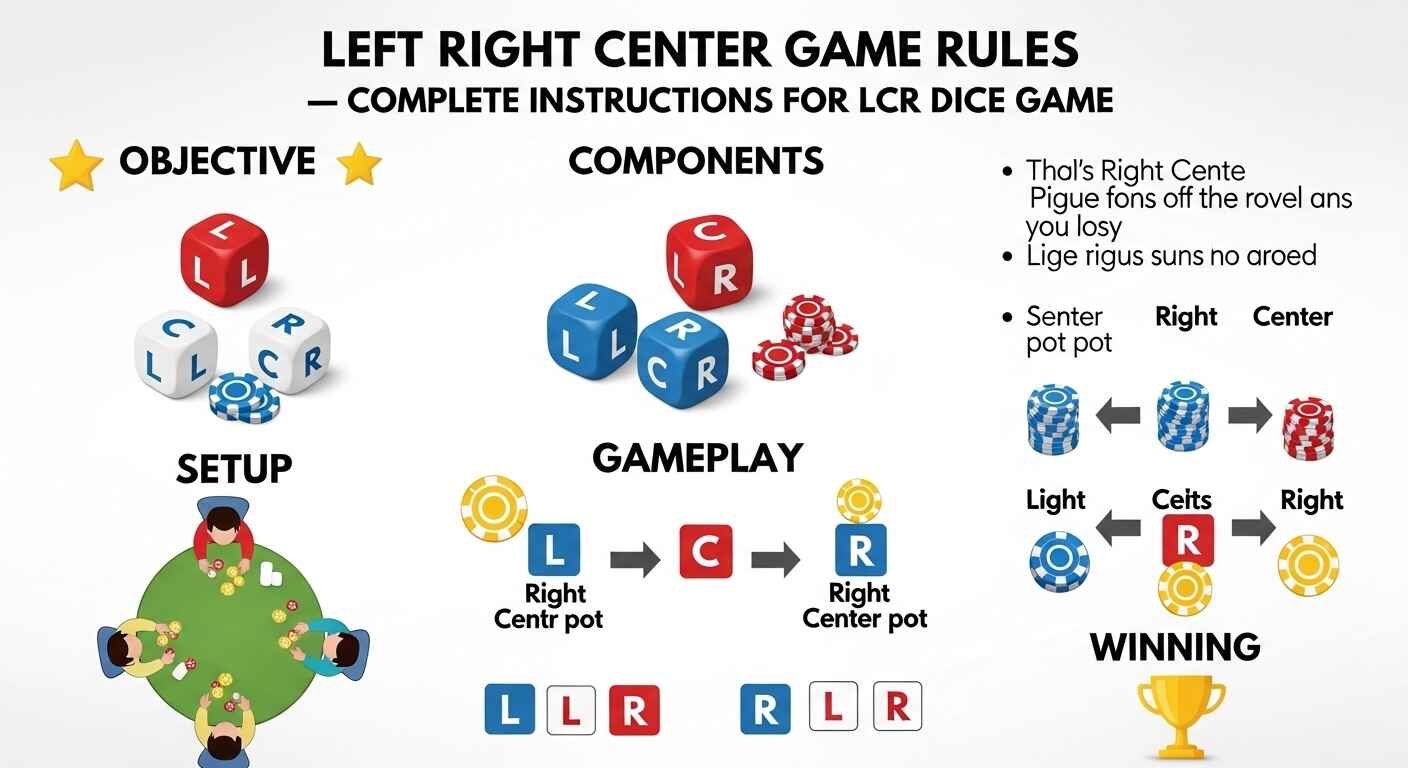
Left Right Center is one of the most played dice games in the world — and also one of the most frequently argued about. The rules fit on a single index card. The game takes five minutes to learn. And yet at least once every session, someone asks a question nobody at the table can answer with certainty.
What happens when you only have one chip left — do you still roll all three dice? What does the star mean exactly — does that chip go to the centre or stay with you? What happens if the player to your left has no chips — do you skip them? Can you win if you’re sitting out?
Every one of those questions has a definitive answer. This guide gives you all of them — the complete setup, every dice symbol explained, every edge case resolved, the best variations, and tips for running the game perfectly whether you’re playing with family, at a party, or using it as a classroom activity.
What Is Left Right Center?
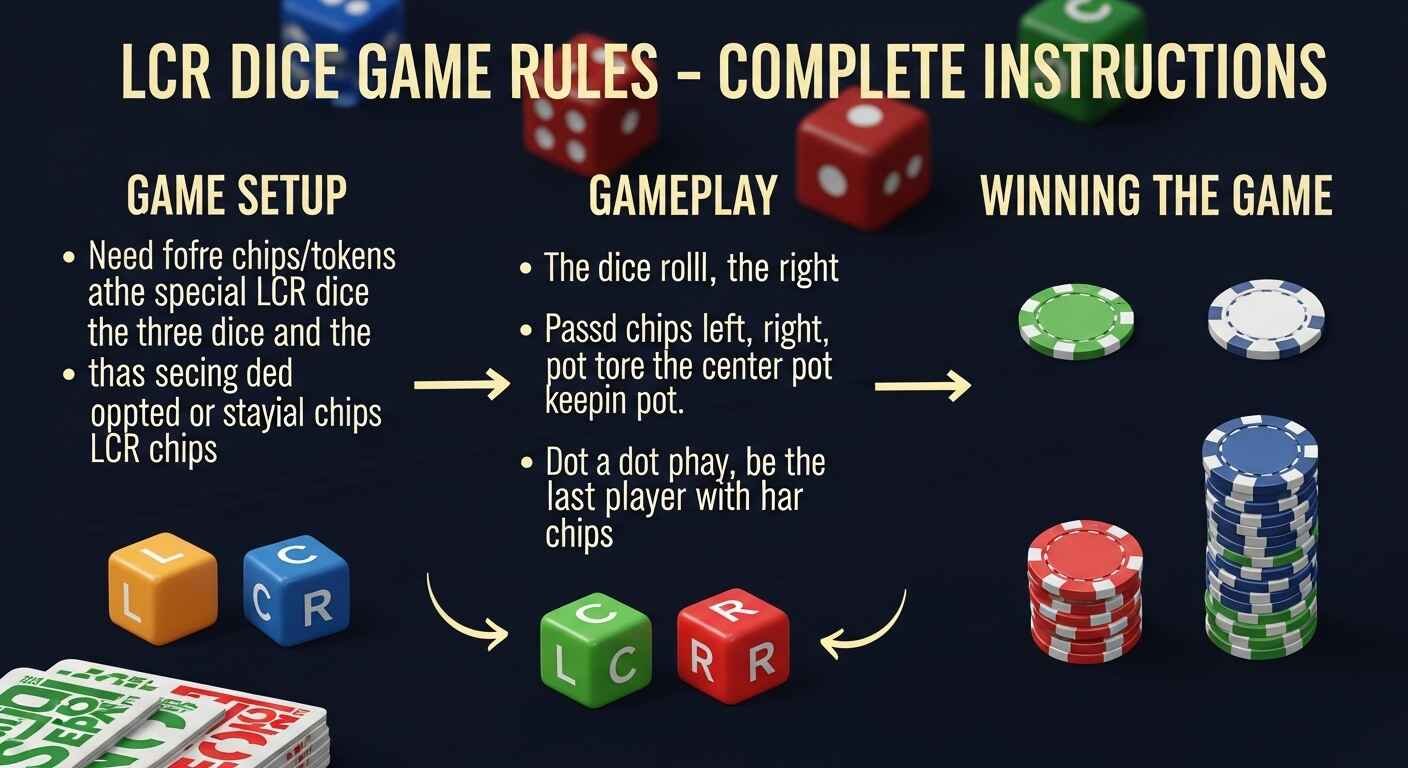
Left Right Center — commonly abbreviated LCR — is a dice game for three or more players published by George & Company LLC. It was created in 1983 and has become one of the bestselling dice games ever made, largely because it requires no strategy, no reading, and no prior gaming experience — making it playable by anyone from age five upward.
Players start with an equal number of chips. On each turn you roll up to three special dice — marked with L, R, C, and dots rather than numbers — and the result determines where your chips go. Chips travel left, right, into the centre pot, or stay with you depending on what you roll. The last player with at least one chip wins everything in the centre pot.
The game is pure luck from start to finish. Nobody makes decisions. Nobody has a strategy. The entire experience is watching chips migrate around the table and into the centre pot while one player slowly emerges as the last person holding anything. That complete absence of skill is exactly why it works — anyone can play it, everyone has an equal chance, and the tension in the final rounds is genuine regardless of age or experience.
What You Need to Play
Official LCR set includes:
- 3 special LCR dice — marked with L, R, C, and dots (·)
- 24 poker-style chips — typically in one colour
- Rules card
If you don’t have the official set: LCR can be played with standard dice modified with stickers, or with written substitutions:
- Roll 1 = L (Left)
- Roll 2 = R (Right)
- Roll 3 = C (Centre)
- Roll 4, 5, 6 = · (Keep / Dot)
Standard six-sided dice substitution works perfectly. Some groups use cards instead of dice — shuffle a deck and draw cards where Ace = L, 2 = R, 3 = C, and all other cards = dot.
Number of players: 3 minimum. No maximum — LCR works with any group size. Larger groups create longer games with bigger centre pots. Groups of 6 to 12 tend to create the most dramatic swings and best gameplay.
Left Right Center — Complete Setup
Step 1 — Distribute Chips Equally
Give every player exactly 3 chips to start. This is the standard starting amount for a quick game.
Variation: For a longer game, start with 5 chips per player. For a very quick game with large groups, start with 2 chips per player.
All chips are identical — they represent your stake in the game. The colour or appearance of chips doesn’t matter.
Step 2 — Place the Dice in the Centre
Put the three LCR dice in the middle of the table within reach of all players. Nobody holds the dice between turns — they always return to the centre after each roll.
Step 3 — Determine First Player
Any random method works — highest roll on a standard die, youngest player, whoever most recently ate pizza. First player advantage is minimal in a luck-based game so method doesn’t matter.
Step 4 — Decide on the Pot Rule
Before the game starts, clarify one house rule: does the game use a centre pot, or does the game use a nominated pot container? Most groups simply leave chips in a central pile on the table — this is fine. Some groups use a bowl or designated centre area for clarity.
The LCR Dice — What Every Symbol Means
This is the heart of the game. Each die face has one of four possible results:
L — Left
Pass one chip to the player immediately to your left.
Left means the player sitting directly to your left around the table — not across the table, not two seats over. Immediately to your left.
R — Right
Pass one chip to the player immediately to your right.
Right means the player sitting directly to your right around the table.
C — Centre
Place one chip into the centre pot on the table.
Chips in the centre pot stay there for the entire game. They cannot be retrieved by any player — not even the person who put them there. Once a chip is in the centre, it belongs to nobody until the game ends.
· (Dot)
Keep the chip. Do nothing. The dot means that chip stays with you.
The dot is the best possible result for the current holder of that chip — it goes nowhere.
How to Take Your Turn — Complete Rules
How Many Dice Do You Roll?
The number of dice you roll depends on how many chips you currently hold:
| Chips You Hold | Dice You Roll |
|---|---|
| 3 or more chips | Roll all 3 dice |
| Exactly 2 chips | Roll 2 dice only |
| Exactly 1 chip | Roll 1 die only |
| 0 chips | Roll NO dice — you sit out this turn |
This is one of the most commonly misplayed rules. Players with fewer than three chips do NOT roll all three dice. The number of dice equals your chip count, capped at three.
Step by Step — Your Turn
Step 1: Count your chips. Determine how many dice to roll.
Step 2: Take the dice from the centre and roll them — only as many as your chip count allows, maximum three.
Step 3: Read each die result and act on them one at a time:
- Each L result: pass one chip to the player on your left
- Each R result: pass one chip to the player on your right
- Each C result: place one chip in the centre pot
- Each · result: keep that chip — do nothing
Step 4: Return the dice to the centre of the table.
Step 5: Your turn ends. The player to your left takes their turn.
Example Turn
Player has 3 chips. Rolls all three dice. Results: L, C, ·
- L → pass one chip to the left
- C → put one chip in the centre pot
- · → keep one chip
Player now has 1 chip remaining. The left neighbour gained 1 chip. The centre pot gained 1 chip.
The Zero Chips Rule — Sitting Out Explained
When a player has zero chips, they sit out their turn — they do not roll any dice.
Critical rule: A player with zero chips is NOT eliminated from the game. They remain at the table and continue taking turns — they just roll no dice during those turns.
Why does this matter? Because a player with zero chips can receive chips from neighbouring players on the very next turn — if a player to their left or right rolls an L or R pointing toward them. A player who had zero chips can suddenly have two or three chips and be fully back in contention.
Zero chips ≠ eliminated. This is the most common LCR misunderstanding. Never remove a player from the game for having zero chips.
Winning the Game
The game ends when only one player has any chips remaining. That player wins and collects all chips from the centre pot.
The winning condition:
- All other players currently hold zero chips
- The winning player holds at least one chip
- On the next player’s turn, if they would roll dice, there are no dice results that could give the winning player’s chips away — because there are no other players with chips to receive them
Wait for the full round: Most groups play until everyone has had an equal number of turns in the final round — meaning if the last chip transfer happens mid-round, all remaining players take their sitting-out turns before the winner is declared. This is a house rule courtesy rather than an official rule but prevents feeling like the game ended prematurely.
What Happens When You Pass to a Player With Zero Chips?
When you roll an L or R and the player in that direction currently has zero chips — you still pass the chip to them. The direction rule is absolute — L always means left, R always means right, regardless of how many chips that player currently holds.
Passing a chip to a zero-chip player brings them back into active play immediately. They now hold one chip and will roll one die on their next turn.
This is what creates LCR’s most dramatic moments. A player who has been sitting out for three or four rounds suddenly receives a chip from a neighbour’s roll, rolls their one die, gets a dot, and is back in contention. Meanwhile the player who seemed certain to win just gave away their last chip to a player who was out of the game entirely.
What Happens When You Pass and the Neighbour Is Absent?
If you’re playing at a large gathering and a player has had to step away temporarily — or if your seating has gaps — chips still pass to the seat position, not to a specific person. The standard house rule is:
Chips pass to the next occupied seat in the relevant direction. Skip empty seats and pass to the nearest player in that direction.
Set this rule explicitly before the game starts in large gatherings to prevent disputes mid-game.
End-Game Edge Cases — Every Situation Resolved
What If Two Players Both Have Chips When Everyone Else Has Zero?
The game continues. Two players with chips is not the end condition — only one player with chips ends the game. Keep playing until chip transfers reduce the field to one.
What If the Last Two Players Both Roll All C Results?
Both their chips go to the centre. Both now have zero chips. Both sit out next turn. The game is in a temporary stalemate — but the next time either player receives a chip from the other’s roll (which can’t happen if both have zero) or through some other mechanism… wait, actually if both players simultaneously reach zero chips simultaneously:
Official ruling: If the last two players simultaneously reach zero chips on the same turn sequence — which cannot technically happen because they take turns, not simultaneous actions — the last player to have had a chip before the round that emptied both of them is the winner. In practice this situation almost never arises because turns are sequential, not simultaneous.
What If the Centre Pot Is Never Won?
The centre pot is always won by the last player holding chips — there’s no scenario where the game ends with chips in the centre unclaimed. The winner always collects the centre pot.
What If a Player Has More Than 3 Chips and Rolls All L, R, C?
With 3 chips they roll 3 dice. All three results could be L, R, C — passing all three chips away. The player now has zero chips. They sit out their next turn. The game continues.
With more than 3 chips, they still only roll 3 dice. So with 5 chips and all L, R, C results — they lose 3 chips and retain 2. On the next turn they roll 2 dice.
Left Right Center Variations
The standard game is excellent but these variations create different experiences for different groups.
Wild Card LCR
Before the game starts, designate one specific die result as a Wild — rolling Wild lets the player choose where to send that chip: left, right, centre, or keep it. On the official LCR dice, the Wild result is typically the second dot face or a house-rule modification.
Creates one moment of decision per roll of the Wild face — minimal strategy added to a luck-based game without fundamentally changing the experience.
LCR Left Right Wild
A commercially available variant where the C face on one die is replaced with a Wild face. Chips sent Wild go to a separate wild pot. When the game ends the wild pot is also awarded. Creates two prize pools.
High Stakes LCR
Play with real small-denomination coins instead of chips. Standard version uses three coins per player — quarters are traditional. The winner takes all coins from the centre pot. Instantly creates genuine investment in every roll. Best played with a predetermined maximum — “we’re playing with three quarters each, winner takes all” — rather than open-ended.
Charity LCR
The centre pot is donated to a designated cause at the end — a tip jar, a group fund, a class charity. Removes the personal winning element and adds collective purpose. Works well for school or workplace settings.
Speed LCR
All players roll simultaneously — no turn order. First player to empty all others wins. Chaotic, fast, and very loud. Works with groups of 5 or fewer — with larger groups simultaneous rolling creates confusion about which chips go where.
Progressive LCR
Instead of starting with 3 chips each, players start with 1 chip. After the first winner is declared, everyone gets 2 chips for game two. Then 3 chips for game three. The player who wins the most games across the progressive session is the overall winner. Good for evenings when you want multiple games without fully resetting.
Tournament LCR
Divide a large group into tables of 4 to 6 players each. Run simultaneous games at each table. Winners from each table advance to a final table. Excellent for large gatherings of 16 or more where a single game with everyone would take too long.
Last Chip Standing Challenge
Each player starts with only 1 chip. Whoever still has a chip after the first full round wins. If multiple players still hold chips after one round — play continues until one player remains. Much faster than standard LCR — typically resolved in three to five minutes. Good as a quick tiebreaker game.
Left Right Center for the Classroom
LCR is one of the best classroom games for zero-prep quick activities. It requires no reading, no strategy, no prior knowledge — making it fully inclusive regardless of academic level. Every student has an equal chance of winning.
Academic adaptations:
Probability lesson: After students understand the basic game, use it as a hands-on probability exercise. What is the probability of rolling L on one die? (1 in 4 for standard LCR dice.) What is the expected number of chips lost per turn when holding 3 chips? (0.75 chips per turn on average.) What is the probability of rolling three dots and keeping all chips? Build the probability discussion around real results from the game.
Fractions practice: Have students track the fraction of chips remaining after each turn. Connect the results to fraction concepts appropriate to the grade level.
Data collection: Have students record their chip counts each turn across a full game. Graph the results. Discuss the shape of the distribution. What patterns emerge? Where do chips tend to concentrate?
Quick reward game: Use LCR as a five-minute reward activity at the end of a lesson. Students receive chips for correct answers during the lesson — more correct answers means starting the game with more chips. This creates a mild academic incentive while the game itself remains purely luck-based from the chip-distribution point onward.
Left Right Center vs Other Dice Games
How does LCR compare to other popular dice games?
| Game | Players | Strategy | Time | Best For |
|---|---|---|---|---|
| Left Right Center | 3+ | None — pure luck | 10–20 min | All ages, large groups |
| Yahtzee | 2–6 | Medium | 30–45 min | Competitive players |
| Farkle | 2–8 | Medium | 30–45 min | Adults and older kids |
| Bunco | 8–12 | None — pure luck | 45–60 min | Large social groups |
| Liar’s Dice | 2–6 | High | 20–30 min | Bluffing enthusiasts |
| Zombie Dice | 2–8 | Low | 15–20 min | Casual gaming groups |
LCR sits firmly in the pure luck category alongside Bunco. Unlike Yahtzee and Farkle — where decisions about which dice to keep and when to stop rolling matter significantly — LCR has zero player decisions after setup. This is its defining characteristic and explains both its appeal to all-ages groups and its limitation for players who want strategic depth.
Play Free Games at SyceGamesHack
Want more free games to play alongside LCR? SyceGamesHack has 160+ free browser games — party games, puzzle games, word games, and multiplayer games — all completely free, no download required, no ads, and fully accessible on school Chromebooks, phones, and any desktop browser.
Zero ads. Zero downloads. Zero sign-up. Open the link and play in seconds.
Related Articles You’ll Love
- Game of Life Rules — the other complete board game rules guide on SyceGamesHack — same clear format, same definitive answers
- How to Play MASH Game — the classic zero-setup fortune-telling game that needs nothing but a pen and paper
- How to Play the Fishbowl Game — the best full-evening party game for the same group that just finished LCR
- Murder Mystery Board Game — the most theatrical board game experience for your next game night
- How to Play the Hashtag Game — zero-setup party game for between LCR rounds
- Imposter Game Generator — free word-based party game with instant setup
- Jeopardy Game Maker — build a custom trivia game for your party night
FAQs
Q: How many dice do you roll if you have fewer than 3 chips?
You roll one die per chip you currently hold, up to a maximum of three dice. If you have 2 chips, roll 2 dice. If you have 1 chip, roll 1 die. If you have 0 chips, roll no dice and sit out your turn. This is the most commonly misplayed rule in LCR — many groups incorrectly have all players roll all three dice regardless of chip count.
Q: Are you eliminated when you run out of chips?
No — never. A player with zero chips sits out their turn but remains in the game. They can receive chips from neighbouring players’ rolls at any moment and return to active play immediately. Players are only out of contention when the game formally ends — which happens only when one player holds all remaining chips.
Q: What does the dot mean on an LCR die?
The dot — sometimes shown as a single dot or asterisk — means keep. That chip stays with you and goes nowhere. The dot is the best possible result for a chip’s current owner.
Q: What happens if you pass a chip left and the player on your left has zero chips?
You still pass the chip to them. The direction rule is absolute — L means the player to your immediate left regardless of how many chips they currently hold. Passing to a zero-chip player brings them back into active play immediately with one chip.
Q: Can you win with zero chips?
No — you cannot win the game while holding zero chips. Winning requires being the last player to hold at least one chip. However a player with zero chips is still in the game and can receive chips from other players — so having zero chips does not mean you have lost.
Q: What happens to chips in the centre pot?
Chips in the centre pot stay there for the entire game. No player can retrieve them during play. When the game ends — when only one player holds any chips — that winning player collects all chips from the centre pot as their prize.
Q: How long does a typical LCR game take?
With the standard three chips per player, a game typically takes ten to twenty minutes regardless of player count. With five chips per player, expect twenty to thirty minutes. With very large groups of twelve or more players, games can run thirty to forty-five minutes because the chip pool is large and takes longer to consolidate.
Q: Can you play Left Right Center with regular dice?
Yes — standard six-sided dice work perfectly as a substitute. Assign: 1 = L, 2 = R, 3 = C, and 4, 5, 6 = dot. This gives the same one-in-six probability per result as using LCR’s four-face custom dice. Some groups use a different distribution — 1–2 = L, 3–4 = R, 5 = C, 6 = dot — which changes the probabilities and creates a slightly different game experience.
Q: Is Left Right Center the same as LCR?
Yes — Left Right Center and LCR refer to the same game. LCR is simply the acronym for Left, Right, Center — the three directions chips travel in the game. Both names appear on packaging from different publishers and editions.
Q: What is the best number of players for Left Right Center?
LCR works with any number from three upward, but the sweet spot is five to eight players. With three or four players the game ends quickly — often in under ten minutes — because the chip pool is small and consolidates fast. With five to eight players the dramatic swings and surprise reversals have more room to develop. With very large groups of twelve or more, consider running two simultaneous games for better pacing.
Q: Does the first player have an advantage in LCR?
No — LCR is pure luck with no strategic decisions, meaning first player position conveys no meaningful advantage. The only mild effect is that the first player has the first opportunity to reduce their chips — which is equally likely to be good or bad depending on the results. Long-term first-player advantage is essentially zero.