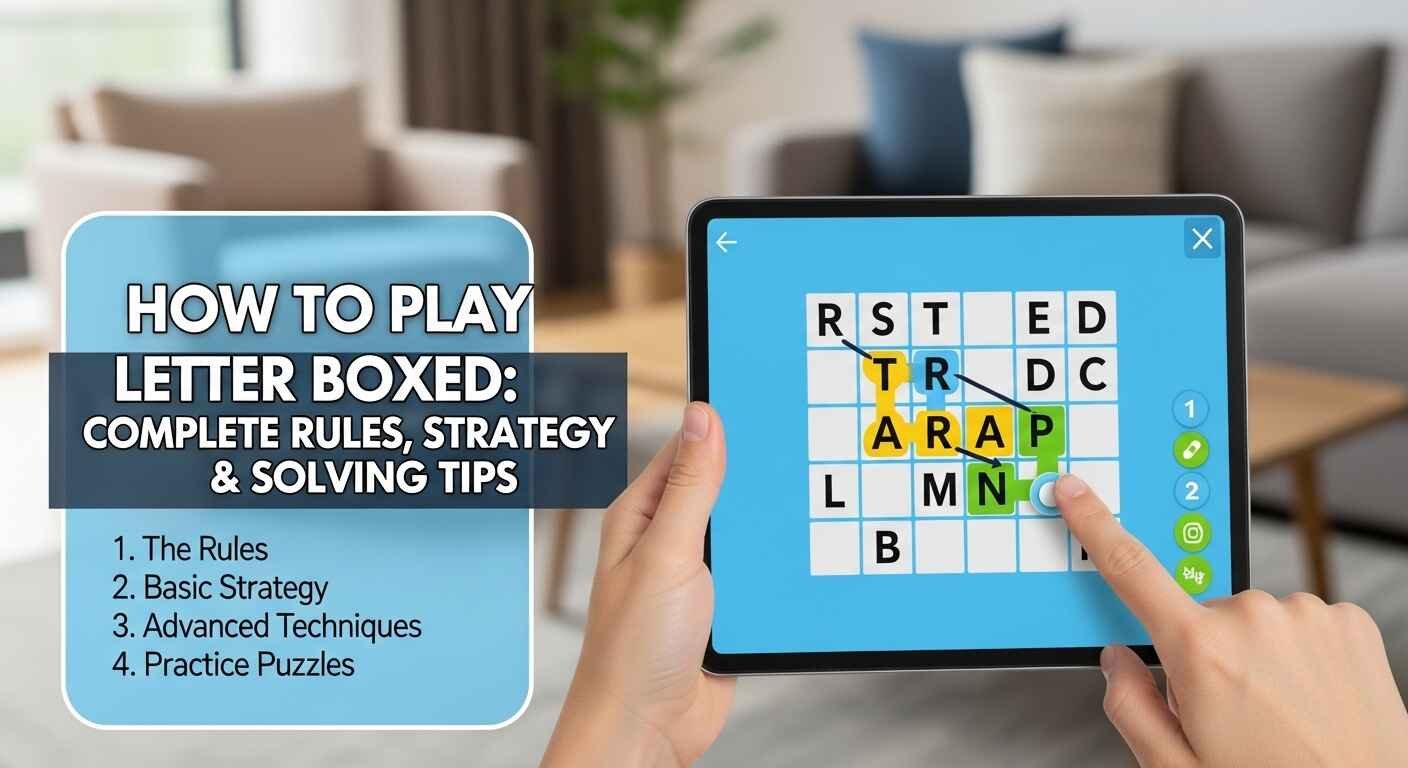
Letter Boxed is one of the most satisfying word games on the internet right now. It’s made by The New York Times — the same team behind Wordle — and it publishes a brand new puzzle every single day. Millions of people play it every morning before they even finish their coffee.
If you’ve seen people posting their Letter Boxed results and had no idea what the grid of letters meant, this guide explains everything from scratch. If you already play but find yourself stuck on harder puzzles more often than you’d like, the strategy section will genuinely change how you approach every board.
What Is the NYT Letter Boxed Game?
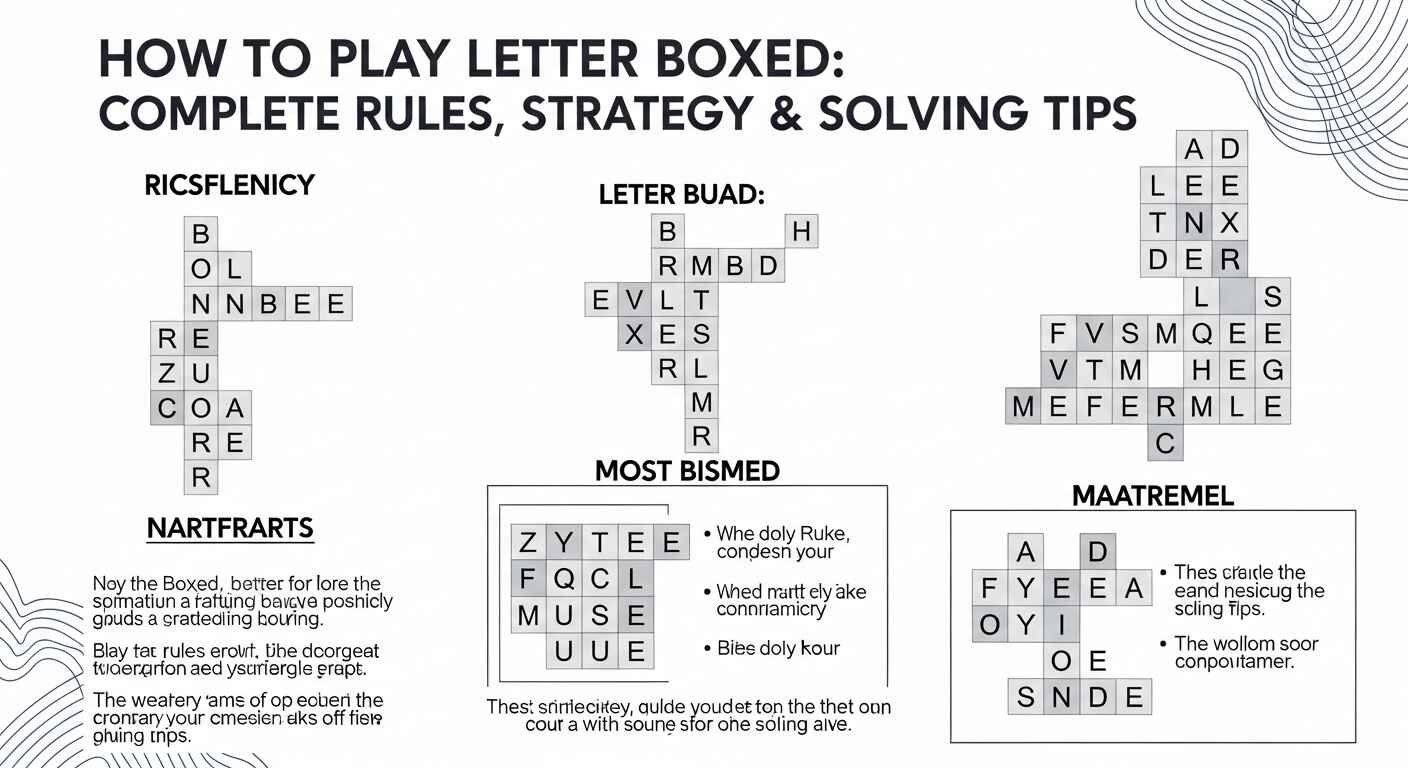
Letter Boxed is a daily word puzzle where you connect letters arranged around the four sides of a square box to form words. The goal is to use every letter on the board in as few words as possible — ideally two or three.
The letters sit on the edges of a square — some on the top side, some on the bottom, some on the left, and some on the right. Each side has exactly three letters, giving you twelve letters total across the four sides.
The catch is the connection rule: each letter in a word must come from a different side of the box than the letter before it. You can’t use two letters from the same side back to back. That one rule is what makes Letter Boxed genuinely challenging rather than just a vocabulary test.
What You Need to Play
Online (recommended): Go to nytimes.com/puzzles/letter-boxed. A new puzzle appears every day at midnight. You don’t need a subscription for the basic daily puzzle. It’s free to play in any browser, including on school Chromebooks and phones.
No account needed for the daily puzzle. You can play directly without signing in.
Offline version: You can draw a Letter Boxed grid on paper yourself — write three letters on each side of a square — and challenge a friend to solve it. It works just as well as a manual activity.
Letter Boxed — Full Rules Explained
The Board
The board is a square with twelve letters arranged around its perimeter — three letters on each of the four sides. Every letter appears exactly once. No repeats.
A typical board might look like this:
        T  A  R
      ┌─────────┐
   O  │         │  N
   P  │         │  E
   S  │         │  I
      └─────────┘
        U  M  G
Left side: O, P, S Right side: N, E, I Top: T, A, R Bottom: U, M, G
The Goal
Use every letter on the board at least once across a chain of connected words. The fewer words you use, the better your score. Most puzzles are designed to be solvable in 2 or 3 words. Getting it in 2 words is considered excellent. Getting it in 5 or more words means you’re still learning — and that’s completely fine.
The Core Connection Rule
Every consecutive pair of letters in a word must come from different sides of the box. You cannot use two letters from the same side back to back.
Example using the board above:
- The word “ROPES” — R is on top, O is on the left, P is on the left. R → O is fine (top to left). O → P is not allowed (left to left — same side).
- The word “ROPES” is invalid on this board.
- The word “ROMAN” — R (top) → O (left) → M (bottom) → A (top) → N (right). Every consecutive pair comes from a different side. Valid.
The Chain Rule
Here’s what makes Letter Boxed uniquely clever: the last letter of each word becomes the first letter of your next word. So your words must chain together — end of word 1 becomes start of word 2, end of word 2 becomes start of word 3, and so on.
This means you can’t just find words at random. You have to find words that connect to each other while collectively covering all twelve letters.
What Counts as a Valid Word
Words must be at least three letters long. The game uses a standard dictionary — proper nouns, abbreviations, and slang are typically not accepted. If the game rejects your word, it either doesn’t exist in its dictionary or it violates the connection rule.
How to Play Letter Boxed — Step by Step
Step 1: Look at the twelve letters on the board. Familiarise yourself with which letters are on which side. This matters because the connection rule is everything.
Step 2: Click any letter to start your first word. A line connects each letter as you select them.
Step 3: Continue selecting letters, making sure each consecutive pair comes from different sides. The game highlights valid next letters as you go — invalid letters gray out automatically.
Step 4: When your word is complete (minimum 3 letters), press Enter or click the check button. If the word is valid, it’s accepted and the letters are marked as used.
Step 5: Your next word must start with the last letter of the word you just completed. Continue until all twelve letters have been used.
Step 6: If you get stuck, the game offers a shuffle button that rearranges the letters visually (not their sides — just the display order). It can help you see combinations you missed.
Step 7: You can reset the board and start over as many times as you need. There’s no penalty for resetting — only your final word count is recorded.
Letter Boxed Scoring — What the Numbers Mean
Letter Boxed doesn’t give you points in the traditional sense. Your score is simply the number of words you used to clear the board. Lower is better.
| Words Used | Rating |
|---|---|
| 2 words | Excellent — share this proudly |
| 3 words | Great — better than most players |
| 4 words | Good — solid for everyday play |
| 5 words | Average — room to improve |
| 6+ words | Keep practicing — you’ll get there |
The New York Times shows a “par” number for each puzzle — usually 5 words — which is the target most players should aim to beat. Getting under par consistently is the real goal.
When you share your result, it shows the number of words you used and the chain of words. This is what people post on social media — it’s the Letter Boxed equivalent of Wordle’s colored squares.
Letter Boxed Strategy — How to Solve Every Puzzle
This is where most guides stop at “look for long words.” That’s not enough. Here’s how players who consistently solve in 2–3 words actually think.
Step 1 — Find Your Rare Letters First
Before you start forming words, scan the board for the hardest letters to use. Letters like Q, X, Z, J, and K are rare in English words. They’re also rare on Letter Boxed boards — but when they appear, they’re the hardest to incorporate.
Identify every rare or awkward letter on the board and ask yourself: what words use this letter? Your solving strategy should build outward from those letters, not from easy common letters you’ll find a use for naturally.
Example: If the board has a J, your first question is “what words contain J that are compatible with the other letters here?” Find those first. Then build around them.
Step 2 — Look for Two-Word Solutions Backwards
The most efficient Letter Boxed players work backwards from a potential two-word solution. Here’s how:
Think of a word that uses mostly letters from one half of the board. Then think of a word starting with its last letter that uses the remaining letters. If the two words together cover all twelve letters, you’ve found a two-word solve.
This sounds hard but becomes intuitive quickly. The key is training yourself to see letters in groups — “what if I used these six letters in word one and these six in word two?”
Step 3 — Prioritise Long Words
A single eight-letter word covers eight of your twelve letters. That leaves only four letters for your second word — much easier to find than trying to divide twelve letters across many short words.
Always try to find the longest valid word on the board before settling for short ones. Four-letter words are the enemy of efficiency. Seven and eight-letter words are your best friends.
Step 4 — Use the Chain Rule to Your Advantage
Remember that your words must chain — last letter of word one becomes first letter of word two. This means the letter where you end your first word determines what you can start with next.
Before committing to a first word, ask: does its last letter give me a good starting point for a second word that covers the remaining letters? If yes, go for it. If the last letter is something like Q or X that’s hard to start a word with, reconsider.
Step 5 — Think in Vowel Clusters
Most Letter Boxed boards distribute vowels across multiple sides. Notice which sides have vowels and plan your words to bounce between vowel-heavy sides and consonant-heavy sides. Words that alternate between vowel and consonant sounds naturally satisfy the connection rule more easily.
Step 6 — Use Uncommon but Valid Word Forms
Letter Boxed accepts plurals, past tenses, and verb forms. The word “JUMPS” is different from “JUMP.” “RAINING” uses more letters than “RAIN.” When you find a root word that works directionally on the board, try adding suffixes to extend it further and cover more letters in a single word.
Letter Boxed Tips for Beginners
Don’t start by looking for words. Start by looking at the board structure. Which sides have mostly consonants? Which have vowels? Where are the rare letters? Thirty seconds of observation before you start clicking saves five minutes of frustration.
Write it out. Open a notes app or grab paper. Write down which letters are on which side. Seeing it written linearly — Top: T A R, Bottom: U M G, Left: O P S, Right: N E I — makes the connections easier to visualize than staring at the box.
Try words you wouldn’t normally try. Letter Boxed accepts a surprisingly large dictionary. Obscure but real words — geological terms, old English words, specialized vocabulary — are often valid. If you think a word exists and follows the rules, try it. The worst that happens is it rejects it.
Don’t reset too early. New players reset the moment they get stuck. Before resetting, try working forward from where you are. Is there a word starting with your current last letter that uses several uncovered letters? Often the path forward exists — you just haven’t seen it yet.
Use the shuffle button. When you’ve been staring at the same board for a while, your brain gets locked into seeing the same patterns. Hitting shuffle rearranges the visual display without changing the rules. Sometimes a fresh visual arrangement breaks your mental block.
Practice on old puzzles. The New York Times archives some previous Letter Boxed puzzles. Playing older ones without time pressure is an excellent way to build pattern recognition before tackling the daily puzzle.
Letter Boxed Answers — Should You Look Them Up?
This comes up constantly in the Letter Boxed community. Is it cheating to look up the answer?
The honest answer: it depends entirely on what you want from the game. If the satisfaction comes from solving it yourself, looking up the answer removes the whole point. If you’re stuck and just want to see how it was done — to learn from it rather than give up entirely — looking at the solution and understanding why it works is genuinely educational.
What most experienced players recommend is setting a personal time limit. Give yourself 10 to 15 minutes of genuine effort. If you can’t crack it, look at just the first word — not the full solution. That hint alone often unlocks the whole puzzle.
At SyceGamesHack we think the game is most rewarding when you push through the stuck feeling. The moment a two-word solution clicks into place after struggling for ten minutes is one of the best feelings a word game can give you.
Letter Boxed vs Other NYT Word Games
The New York Times now has a full suite of daily word games. Here’s how Letter Boxed compares to the others:
| Game | Type | Difficulty | Time to Play | Daily Puzzle |
|---|---|---|---|---|
| Letter Boxed | Word chain puzzle | Medium–Hard | 5–15 mins | ✅ Yes |
| Wordle | Word guessing | Easy–Medium | 2–5 mins | ✅ Yes |
| Connections | Word grouping | Medium | 3–7 mins | ✅ Yes |
| Spelling Bee | Word building | Hard | 10–60 mins | ✅ Yes |
| Mini Crossword | Crossword | Easy | 1–3 mins | ✅ Yes |
Letter Boxed sits in the middle ground — harder than Wordle and the Mini Crossword, more contained than Spelling Bee. It’s the best choice if you want something that genuinely tests vocabulary and spatial thinking without consuming your whole morning.
Play Free Word Games at SyceGamesHack
Can’t access the NYT games at school? SyceGamesHack has a full library of free word games and puzzle games you can play instantly in your browser — no downloads, no sign-up, no ads, and no blocks. Works perfectly on school Chromebooks, phones, and any desktop browser.
Over 160 games are available free right now. Word games, party games, puzzle games, and multiplayer games — all in one place, all completely free, all ad-free.
Letter Boxed — Advanced Techniques for Experienced Players
Once you’re consistently hitting 3-word solutions, these techniques push you toward regular 2-word solves.
The Palindrome Scan. Look for letters that appear on opposite sides of the board from each other. Letters on opposite sides can alternate freely in a word — A (top) → B (bottom) → A (top) is valid because you’re switching sides each time. This means letter pairs on opposite sides can repeat in a single long word, opening up words you’d otherwise miss.
The Suffix Stack. Find the longest word that fits the directional rules, then check if adding common suffixes — -ING, -ED, -LY, -TION, -NESS — creates a longer valid word that covers more letters. A seven-letter root that becomes a ten-letter word with a suffix can single-handedly cover most of the board.
Anchor on Transition Letters. Some letters appear naturally at word boundaries S endings, Y endings, E endings that chain smoothly into a next word. When scanning for your first word, prioritize words ending in letters that give you strong starting options for word two. Words ending in A, E, I, O, Y, and S tend to chain most easily.
The Two-Word Mirror. For advanced players: look for two words where word one ends on the side that word two starts on — and word two covers mostly the sides that word one didn’t. You’re essentially splitting the board in half and conquering each half with one word. This is the structural logic behind most clean two-word solutions.
Related Games You’ll Love
If you enjoy Letter Boxed, these free games at SyceGamesHack scratch a similar itch:
- Nerdle Game the math-based daily puzzle game with similar solve logic
- Word Chain Game fast-paced word association with the same chain mechanic
- Hashtag Game creative word party game for groups
- Say the Word on Beat rhythm-based word challenge under time pressure
- MASH Game the classic student favourite for when you need a break from puzzles
- Chameleon Game social deduction word game for groups
FAQs
Q: Is Letter Boxed free to play?
Yes. The daily Letter Boxed puzzle is completely free at nytimes.com/puzzles/letter-boxed. You do not need a New York Times subscription to play the daily game. Some archived puzzles and additional features may require a subscription, but the core daily puzzle is always free.
Q: How often does the Letter Boxed puzzle reset?
A new puzzle is released every day at midnight Eastern Time. Once you complete the daily puzzle, you can’t replay it — you wait until midnight for the next one. This is the same schedule as Wordle and other NYT daily games.
Q: What’s the minimum word length in Letter Boxed?
Words must be at least three letters long. Two-letter words are not accepted regardless of whether they exist in the dictionary. This is a hard rule built into the game.
Q: Can you use the same letter twice in a word?
Yes — you can use a letter multiple times in a single word as long as you don’t use two letters from the same side consecutively. The letter itself can repeat, but the side must change each time you pick a letter. This opens up words like “RARER” or “LEVELED” when the board letters are distributed across the right sides.
Q: Does Letter Boxed accept proper nouns?
No. Proper nouns — names of people, places, and brands — are not accepted. The game uses a standard English dictionary of common words. Country names, city names, and personal names will all be rejected.
Q: Can you replay the Letter Boxed puzzle if you get stuck?
Yes — you can reset the board as many times as you want within the same session. Resetting clears your progress and lets you start fresh. There’s no penalty for resetting, and your final word count is the only thing recorded.
Q: Why does Letter Boxed reject words I know are real?
Two possible reasons. First, the word might violate the connection rule — consecutive letters from the same side. Double-check your letter path. Second, the word might not be in the NYT’s specific dictionary, which skips very obscure words, slang, and regional terms. The dictionary is large but not exhaustive.
Q: What is a good score in Letter Boxed?
Solving in 2 words is excellent. Solving in 3 words is above average and something to be proud of. The NYT publishes a “par” score with each puzzle — typically 5 words — and beating par consistently puts you in the top tier of regular players.
Q: Is there a Letter Boxed app?
The NYT Games app includes Letter Boxed alongside Wordle, Connections, and Spelling Bee. The app is available on iOS and Android. However the web version at nytimes.com/puzzles/letter-boxed works just as well in any mobile browser and doesn’t require a download.
Q: How is Letter Boxed different from Wordle?
Wordle asks you to guess a specific five-letter word in six attempts using color-coded feedback. Letter Boxed gives you twelve letters around a box and asks you to chain words together to use every letter. Wordle tests word recognition and deduction. Letter Boxed tests vocabulary, spatial thinking, and word-chaining logic. They’re both daily word games but play completely differently.