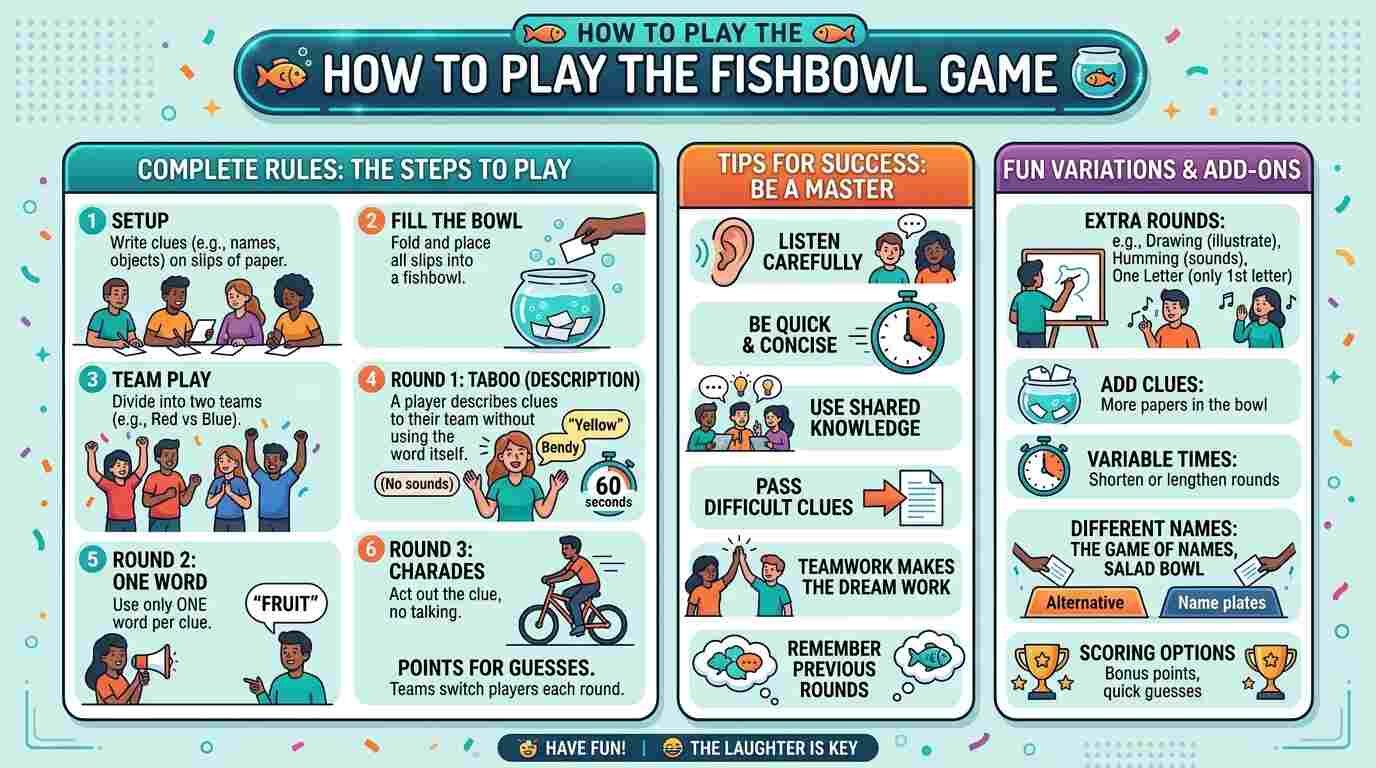
Fishbowl Game is the best party game most people have never heard of by its proper name. You’ve probably played a version of it, maybe called Celebrity, maybe called Salad Bowl, maybe just “that game where you write names on paper.” Whatever you called it, the night it was played was almost certainly one of the funniest game nights you can remember.
The reason Fishbowl works so well is the three-round structure. Round one is easy and loud. Round two is harder and hilarious. Round three is almost impossible and completely chaotic. The same words cycle through all three rounds, which means by round three, everyone is desperately signalling words they couldn’t get across in round one, and the whole room is howling.
This guide covers everything from scratch: the full rules for all three rounds, how to set up the game, team strategies, the best variations, tips for running it perfectly, and how to play it with any group size from six players to thirty.
What Is the Fishbowl Game?
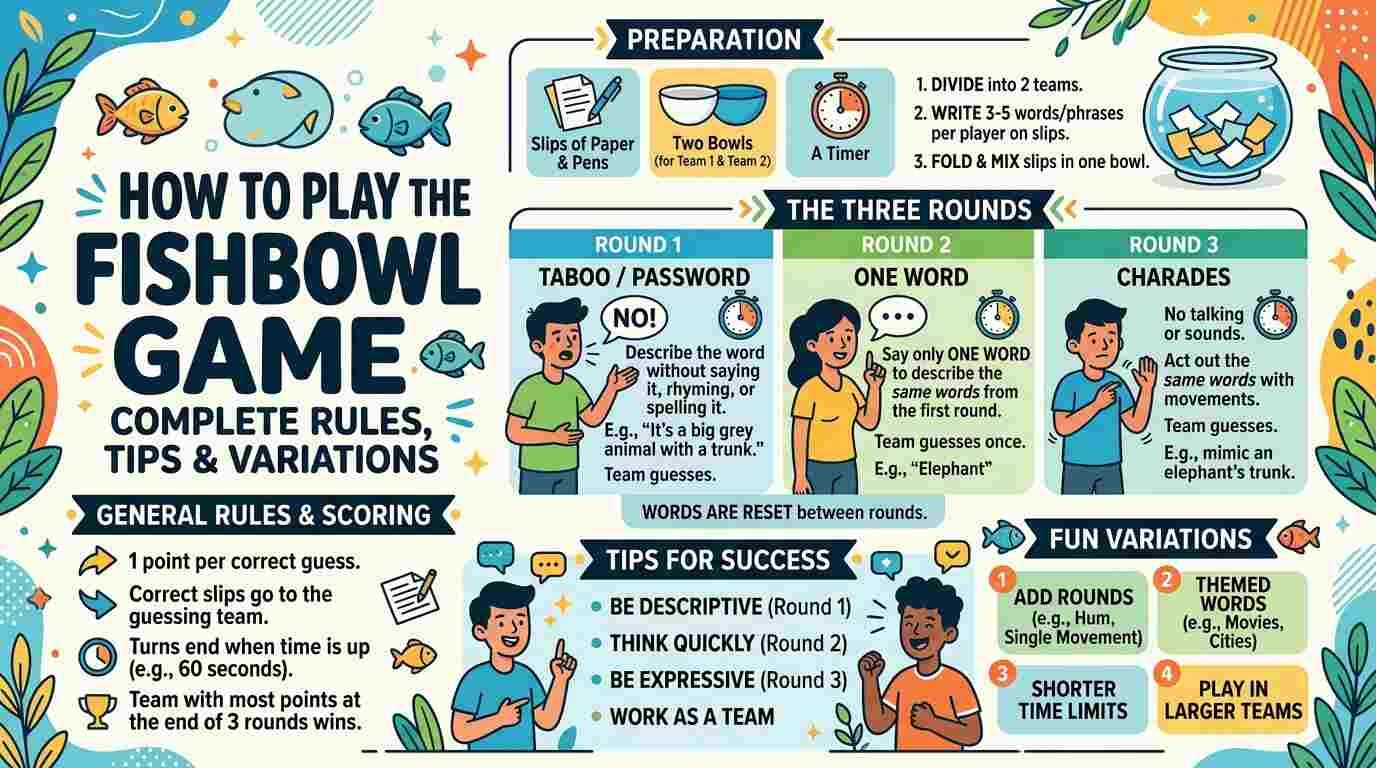
Fishbowl is a team-based party game that combines three classic word games into one progressive session — Taboo, Password, and Charades — using the same set of words across all three rounds.
Here’s the core structure:
Every player writes several words or phrases on slips of paper and puts them into a bowl — the fishbowl. All slips are shuffled together. Teams take turns drawing from the bowl and getting their teammates to guess the word using different clue rules for each round.
The same slips cycle through all three rounds:
- Round 1: Describe the word using any words except the word itself — like Taboo
- Round 2: One word only — like Password
- Round 3: No words — silent acting — like Charades
Because everyone has already heard the words in round one, rounds two and three become progressively funnier and more frantic as players try to trigger memories of earlier clues with increasingly restricted tools.
The team that correctly guesses the most words across all three rounds wins.
What You Need to Play
- 6 or more players — works up to any size, best with 8 to 20
- Paper and pens — one per player for writing words
- A bowl, hat, bag, or box — anything to hold the folded slips
- A timer — phone timer works perfectly
- Something to keep score — notepad or whiteboard
Total setup time: under five minutes. Zero cost if you have a mixing bowl and scrap paper.
Fishbowl Game — Complete Setup
Divide Into Two Teams
Split all players into two roughly equal teams. Teams sit on opposite sides of the room or at opposite ends of a table so players can gesture and act without their opponents seeing too easily.
For larger groups — twelve or more — three teams work well. Four teams work with very large gatherings. The core rules don’t change with more teams — you just adjust turn order.
Every Player Writes Words on Slips
Each player writes a set number of words or phrases on separate slips of paper — one word or phrase per slip. The standard number is three to five slips per player, depending on group size.
Guidelines for what to write:
The words should be recognisable to most players in the room but not so obvious that they’re trivially easy. The sweet spot is names, phrases, and concepts that most people know but might struggle to describe or act out under pressure.
Good categories to draw from:
- Famous people — real or fictional — living or historical
- Movie titles, TV show names, book titles
- Famous characters — fictional characters from any medium
- Places — cities, countries, landmarks
- Objects — anything physical
- Actions or events
- Abstract concepts — love, jealousy, democracy
House rule on difficulty: Most experienced groups mix difficulty levels — some easy slips like “pizza” or “Barack Obama,” some medium like “the Great Wall of China” or “procrastination,” some hard like “the Renaissance” or “quantum physics.” The mix creates variety across all three rounds.
Fold Slips and Add to the Bowl
Every player folds their slips and drops them all into the central bowl without showing anyone. Give the bowl a good mix so slips are thoroughly shuffled.
Decide Turn Order
Flip a coin or play rock-paper-scissors to decide which team goes first. After the first team takes a turn, teams alternate. Within each team, rotate which player is the clue-giver each turn — everyone should have multiple turns across all three rounds.
Set Your Timer
The standard turn length is thirty to sixty seconds depending on your group’s preference. Thirty seconds creates more pressure and faster pace. Sixty seconds is better for larger groups where you want more words guessed per turn. Most groups land on forty-five seconds as the sweet spot.
Fishbowl Game — Round by Round Rules
Describe It (Taboo Style)
The rule: The clue-giver draws a slip from the bowl and describes the word to their team using any words, sounds, or gestures they like — except:
- They cannot say the word itself or any part of it
- They cannot spell the word out
- They cannot say “it rhymes with…”
- They cannot use direct translations in other languages
How it works:
The clue-giver draws one slip, reads it privately, and starts describing as fast as possible. Their team shouts guesses freely — no turn-taking, just rapid-fire calling out of answers.
The moment the team correctly says the word, the clue-giver takes the slip out of the bowl and keeps it — that’s a point for their team. They immediately draw the next slip and continue describing.
The clue-giver keeps drawing and describing until the timer runs out. Every correctly guessed slip is one point. Slips that are too hard or where the team is getting stuck can be skipped — but skipped slips go back into the bowl and are available for the opposing team.
When the timer runs out:
The turn ends immediately. Any slip currently being described goes back into the bowl. All correctly guessed slips from this turn are set aside as that team’s points.
The other team now takes their turn — same rules, new clue-giver from their team.
when the bowl is completely empty. All slips have been correctly guessed. Count each team’s slips — that’s their Round 1 score.
One Word Only (Password Style)
The setup: All correctly guessed slips from Round 1 go back into the bowl. The same words play again.
The rule: The clue-giver draws a slip and can say exactly one word — nothing more. One word. Singular. After saying their one word, they must wait for their team to guess before drawing the next slip.
No gestures. No sounds. No expressions beyond natural reactions. One word.
Why this round is brilliant:
By Round 2, everyone has heard every word in the bowl at least once during Round 1. A single carefully chosen word can trigger that memory immediately — or it can completely mislead and the team goes on a wrong tangent while the timer ticks.
The clue-giver’s choice of which single word to use becomes the entire game. “Stripes” for “zebra” is solid. “Africa” for “zebra” is riskier because it fits many animals. “Horse” for “zebra” is clever if the team remembers a specific Round 1 moment. “Black” for “zebra” is dangerous — they might guess “panther” or “crow.”
How it works:
Clue-giver draws a slip, says one word. Team guesses. If correct, that slip is a point and the clue-giver draws the next slip immediately. If incorrect, the clue-giver cannot say anything further — they must wait. The team keeps guessing until they get it right or everyone agrees to skip.
Skipped slips go back in the bowl for the opposing team.
when the bowl is empty again. Count scores. Running total from both rounds is tracked.
Silent Acting (Charades Style)
The setup: All slips go back in the bowl one final time.
The rule: No words. No sounds. No mouthing words silently. Pure physical acting only.
The clue-giver draws a slip and must get their team to say the word using only gestures, movements, and expressions. Standard charades signals are allowed:
- Holding up fingers to indicate number of words
- Pulling your ear for “sounds like”
- Tapping your arm for syllables
- Making a movie camera gesture for “movie title”
- Pulling your hands apart for “longer word”
- Pushing hands together for “shorter word”
Why this round is the best:
By Round 3 every player has heard these words twice — once described in detail in Round 1, once triggered by a single word in Round 2. The memory of those rounds is fresh. A single specific gesture can immediately trigger the right answer from a team that has been primed across two previous rounds.
The comedy comes from watching someone desperately try to act out “quantum physics” or “the Renaissance” after sixty seconds of trying. The team often gets there — sometimes from the faintest ghost of a gesture — because the word is already living somewhere in their memory from the earlier rounds.
when the bowl is empty for the final time.
Scoring and Winning
Add up each team’s correctly guessed slips across all three rounds. The team with the most total slips wins.
Standard scoring:
| Round | Points Per Slip |
|---|---|
| Round 1 | 1 point |
| Round 2 | 1 point |
| Round 3 | 1 point |
Bonus scoring variation — escalating points:
| Round | Points Per Slip |
|---|---|
| Round 1 | 1 point |
| Round 2 | 2 points |
| Round 3 | 3 points |
Escalating points rewards teams that perform well in the harder rounds and can turn around games that seemed decided after Round 1. This variation is recommended for competitive groups who want the final round to feel genuinely decisive.
Fishbowl Game Tips — How to Win Every Round
How to Write Strong Slips
The slips you write shape the entire game. Strategic players think carefully about what to write.
- Write words your team knows better than theirs. Inside references that your team will instantly recognise but the opposing team won’t are legal and ruthlessly effective. The opposing team has to describe and guess those words too — and they’ll struggle with references they don’t recognise.
- Include one or two extremely easy words. “Dog,” “pizza,” “the moon” — simple words that will fly through all three rounds and rack up three guaranteed points. Don’t be too clever with every slip.
- Include one or two extremely specific words. Words that are very hard to describe but very memorable once described — “schadenfreude,” “the Eiffel Tower at night,” “the feeling of forgetting why you walked into a room” — become legendary in Round 2 and 3 because one specific clue triggers the whole memory.
- Avoid words that are too abstract without context. “Justice” or “time” are so broad that they’re nearly impossible in Round 3 charades without a very specific acting approach. Choose abstract concepts with clear physical representations or distinctive cultural associations.
Strategy — Spend Words, Not Time
In Round 1 you have unlimited words — use all of them. Speak fast, give multiple angles on the same word, use examples, use gestures alongside your words. Your goal isn’t elegance — it’s speed.
The more slips your team gets through in Round 1, the more their memories are loaded for Rounds 2 and 3. Teams that dawdle in Round 1 pay for it in Round 3 when they’re acting out words their team barely heard described.
Pro move: When describing, give a memorable unique association alongside the basic description. Don’t just say “it’s a big grey animal with a trunk” for elephant — add “we saw one at the zoo last summer” or “it’s the one Jake always messes up in charades.” That specific addition becomes the trigger in Round 3.
Strategy — Think From Your Team’s Perspective
The temptation in Round 2 is to choose the most accurate single word. The better strategy is to choose the word your specific team will most immediately associate with the answer.
Before saying your word, ask yourself: what does my team already know about this word from Round 1? What clue was used? What was the breakthrough moment when they guessed it? Your Round 2 word should echo that breakthrough, not describe the word from scratch.
Example: If “Eiffel Tower” was described in Round 1 as “the thing my friend climbed drunk on her gap year in Paris” — the Round 2 word “Paris” is weaker than “drunk” because “drunk” is the specific trigger from Round 1. Use the memory, not the dictionary definition.
Strategy — Commit Completely
Half-hearted charades acting is the biggest Round 3 mistake. Commit to every gesture with full body energy. Teams read commitment as confidence — if you seem sure about your acting, they’ll trust their first instinct rather than second-guessing.
For abstract words: Find the physical manifestation. “Love” — act out a hug, a heart shape, looking at someone adoringly. “Democracy” — act out voting, raising hands. Every abstract concept has a physical expression if you commit to finding it.
For famous people: Lead with their most iconic physical trait or action. Albert Einstein — wild hair, pointing to a chalkboard. Usain Bolt — sprinting, then the signature lightning bolt pose. One strong iconic image is better than a vague general acting scene.
Use your team’s Round 1 memories deliberately. If during Round 1 your teammate used a specific physical joke while describing a word — recreate that exact gesture in Round 3. Inside references from earlier in the same game are the most powerful Round 3 tools available.
How to Host Fishbowl Perfectly — Host Tips
- Designate a neutral scorekeeper. Choose one person who isn’t playing or who sits out of active competition to keep score and manage the bowl. Disputes about whether a word was correctly guessed before the timer are significantly reduced when a neutral third party is tracking.
- Keep the bowl central and accessible. The clue-giver needs to draw from the bowl quickly — don’t make them walk across the room between slips. Central table positioning with the bowl within easy reach of the active clue-giver keeps the pace up.
- Enforce the timer strictly. Generous timers reward slow describers. Strict timers create the pressure that makes the game electric. The moment the timer goes off, the turn ends — no finishing the current word, no one more guess. Enforce this consistently from the first turn.
- Read slips privately and quickly. Clue-givers sometimes stall on a difficult slip, reading and re-reading before deciding how to describe it. Establish the rule that once you draw a slip you must immediately start describing — no pause to strategise. This keeps energy high and prevents one player from slowing the entire game.
- Handle disputes quickly. Occasionally a guess is close but not exact — “the White House” versus “the White House in Washington” — or a clue-giver accidentally says part of the word. Make a fast ruling and move on. Mid-game arguments kill momentum. Establish your house rules before Round 1 starts:
- Partial answers accepted or not?
- If the clue-giver slips up, does the slip go back in the bowl or is it forfeited?
- Are sounds allowed in Round 3?
- Manage team size for balance. If teams are uneven — one team has seven players and the other has five — the larger team’s players get fewer individual turns. Balance this by giving the smaller team slightly longer turn times or an extra clue-giver per turn. The game works best when everyone gets roughly equal participation.
Fishbowl Game Variations
Once your group has played the standard three-round version, these variations create fresh experiences.
Four-Round Fishbowl
Add a fourth round after charades — humming only. Players hum the tune of a song associated with the word, or hum a sound that represents the word’s most obvious audio association. No words, no gestures, just humming.
This works best when slips include movie titles, songs, or characters with iconic musical themes. “James Bond,” “Star Wars,” “Happy Birthday” — these become immediately obvious when hummed. Abstract concepts become genuinely impossible and hilarious.
Theme Night Fishbowl
Restrict the writing category to a specific theme for the entire game. All slips must come from that theme.
Great theme nights:
- Movies only — all slips are movie titles
- Gaming night — all slips are video game titles or characters
- History night — all slips are historical figures or events
- Pop culture — all slips are celebrities, musicians, or TV characters
- School subjects — all slips relate to academic content (excellent classroom version)
Theme nights work particularly well for groups with shared interests — a group of gamers playing Gaming Night Fishbowl will have a dramatically better game than with random mixed categories.
Speed Fishbowl
No fixed team turns. The bowl sits in the centre. Any player from either team can grab a slip at any time — but only one person can be actively describing at once. First team to a target score wins.
Creates a chaotic free-for-all where fast players dominate but team communication becomes critical. Very high energy. Best for groups comfortable with the standard rules who want something more anarchic.
Solo Fishbowl Challenge
One player against the clock. All slips in the bowl. Timer set for three minutes. The solo player must get through as many slips as possible across all three rounds — one minute per round — by themselves. They describe, guess, and act to an imaginary partner, counting their own correct identifications.
Best used as a challenge between competitive players who want to test individual vocabulary and acting skill. Also works as an elimination qualifier — the player who gets through the most slips solo in a set time wins a bonus token for the main game.
Fishbowl With Penalties
Any incorrect guess that the clue-giver confirms as wrong costs the team one point. Creates much more cautious guessing strategy — teams stop shotgunning random answers and start thinking before calling out. Recommended for experienced groups where the standard game has become too easy.
Remote Fishbowl
Fishbowl works excellently over video call with one adjustment to the bowl mechanic. Use a shared Google Doc or online random word picker instead of a physical bowl. One player manages the digital list and privately messages each clue-giver their word at the start of each turn.
Everything else stays the same — description, one-word, charades across three rounds — except Round 3 charades requires good webcam positioning so acting is visible to teammates. Screen-sharing the word list for everyone to track which words have been used keeps the game transparent.
Fishbowl Game for Large Groups
Fishbowl scales better than almost any other party game. Here’s how to manage it at different group sizes:
6–10 Players — Standard Rules
Two teams of three to five. Standard setup applies. Turn length: 45 seconds. Slips per player: four to five. Total slips in bowl: 24–50.
11–20 Players — Extended Setup
Two or three teams. Increase slips to three per player to keep the bowl from being too sparse relative to group size. Turn length: 60 seconds. Consider escalating point values to keep large teams competitive. Rotating clue-givers more deliberately — keep a written order within each team so nobody misses a turn.
21–30 Players — Event Scale
Three or four teams. Reduce slips to two per player — a thirty-person game with five slips each produces 150 slips which makes rounds interminable. Two slips per player at twenty-five players gives 50 slips — manageable across three rounds at sixty-second turns. Consider running simultaneous bowls between multiple pairs of teams rather than one central bowl.
30+ Players — Audience Participation Format
One team of three active players competes at the front while the rest of the group watches and keeps score. Rotate active teams every round. Works well for school assemblies, company events, or party settings where not everyone needs to be an active player simultaneously.
Fishbowl Game for the Classroom
Fishbowl is one of the best classroom review games available. It covers vocabulary, comprehension, and recall across three increasingly challenging formats — which maps directly onto Bloom’s Taxonomy learning levels.
How to adapt it for classroom use:
Restrict the slip category to lesson content. All words must come from the current unit — vocabulary words, historical figures, scientific concepts, literary characters. Students writing the slips must know the words well enough to describe and act them, which is itself a review exercise.
Use it as a formative assessment. Watch which words consistently stump teams across all three rounds — those are the concepts that need more teaching time before the unit assessment.
Run it in small groups. Instead of one class-wide game, run six groups of five simultaneously. Each group has their own bowl and runs all three rounds independently. More participation per student, less waiting time.
Award bonus points for academic accuracy. In Round 1, clue-givers must use accurate subject-specific vocabulary in their descriptions — not just everyday language. This turns the game into a disciplined vocabulary exercise while remaining fun.
Use as an end-of-unit celebration. A well-timed Fishbowl game the day before a test is an effective low-stress review that covers the full range of unit content in a format students genuinely enjoy.
Play Free Party Games at SyceGamesHack
Want more free party and word games to play between Fishbowl sessions? SyceGamesHack has 160+ free browser games — party games, word games, puzzle games, and multiplayer games — all completely free, no download required, no ads, and fully accessible on school Chromebooks, phones, and any desktop browser.
Zero ads. Zero downloads. Zero sign-up. Open the link and play instantly.
Related Games You’ll Love
If you enjoy Fishbowl, these free games at SyceGamesHack are essential:
- Chameleon Game — one-word clues and social deduction — shares Fishbowl’s one-word round DNA
- MASH Game — the classic zero-setup student favourite for between rounds
- Hashtag Game — creative prompt party game that works perfectly as a Fishbowl warm-up
- Say the Word on Beat — rhythm-based word categories under pressure — great pre-Fishbowl warm-up
- Imposter Game — one-word clues with hidden roles — the competitive version of Fishbowl’s Round 2
- Word Chain Game — vocabulary under pressure in a different format — excellent cool-down after Fishbowl
- Jeopardy Game Maker — build a custom trivia game for the same group that just finished Fishbowl
FAQs
Q: How many players do you need for the Fishbowl Game?
Fishbowl works with a minimum of six players three per team. The game gets significantly better as you add more players up to around twenty, where everyone participates actively and the slip pool is large enough for all three rounds to feel full. Beyond twenty players, adjust the format using the large group guidelines above. There’s no real upper limit — the game scales to any gathering with the right adaptations.
Q: How many words should each player write?
Three to five slips per player is standard. For smaller groups of six to eight players, five slips each gives you 30 to 40 total slips — enough for all three rounds to feel substantial. For larger groups of fifteen or more, three slips per player prevents the game from running too long. Adjust based on how long you want the game to last — roughly one minute of play per five slips in the bowl per round is a useful estimate.
Q: Can you use phrases instead of single words?
Yes — phrases are not only allowed but encouraged. “The Eiffel Tower,” “procrastinating on homework,” “the moment before a roller coaster drops” vivid phrases are often more fun to describe, clue, and act than single words. The only restriction is length very long multi-clause phrases become impractical in Round 3 charades. Two to five word phrases are ideal.
Q: What happens if a player accidentally says the word in Round 2 or Round 3?
The most common house rule is that the slip goes back into the bowl immediately with no point awarded to either team. The clue-giver draws the next slip and continues their turn. Some groups add a one-point penalty to the offending team for rule violations establish your preference before Round 1 starts to avoid mid-game disputes.
Q: Can teams see each other’s slips during the game?
No — slips are read privately by each clue-giver and kept face-down after being correctly guessed. The opposing team should never know which specific slip is being described during an active turn. This is partly practical, if the opposing team hears how a word was described in Round 1, they gain an advantage in their own Round 2 and 3 turns with that word. Keep guessed slips in a face-down pile away from the opposing team.
Q: What do you do if the bowl runs out during a team’s turn?
If a team draws the last slip and correctly guesses it mid-turn, that round ends immediately regardless of time remaining on the timer. Tally the round scores and move to the next round setup. The turn doesn’t continue with an empty bowl, partial turns at round end don’t carry over.
Q: Is Fishbowl the same as the Celebrity Game?
Yes — the game is known by multiple names depending on region and group. Celebrity, Salad Bowl, the Hat Game, and Fishbowl all refer to essentially the same three-round structure. Some regional versions have slight rule differences, Celebrity sometimes uses only famous people as valid slips, for example — but the core mechanic of three progressive rounds with the same words is identical.
Q: How do you handle a word that’s too hard to act out in Round 3?
If a team genuinely can’t get a word after fifteen seconds of charades, they can pass, the slip goes back into the bowl and the clue-giver draws the next one. Passed slips are available for the opposing team during their turn. Don’t let a single impossible slip consume the entire turn, passing costs nothing except giving the opposing team a chance at it.
Q: Can you play Fishbowl with just two people?
The competitive team format doesn’t work with two people, but you can play a cooperative two-player version where both players work together to get through the bowl as fast as possible across all three rounds, trying to beat a personal best time. It loses the team competition element but preserves the three-round escalation mechanic that makes Fishbowl unique.
Q: What’s the best theme for a Fishbowl game?
Mixed categories work best for general groups, a blend of famous people, objects, movie titles, and concepts creates the most variety across all three rounds. For groups with specific shared interests, gamers, movie fans, sports fans, themed nights where all slips come from that interest area create more inside-reference moments and generally funnier games. For classroom use, restrict to lesson content for maximum educational value.