Nerdle is the math version of Wordle — and it’s significantly harder. Instead of guessing a five-letter word, you’re guessing an eight-character mathematical equation. Every day a new equation is published. Every day millions of math lovers and puzzle addicts try to crack it in as few attempts as possible.
If you’ve never played Nerdle before, this guide walks you through everything from scratch — what the colors mean, how the rules work, and how to think about equations rather than words. If you already play but keep needing five or six attempts, the strategy section will cut that down immediately.
What Is the Nerdle Game?
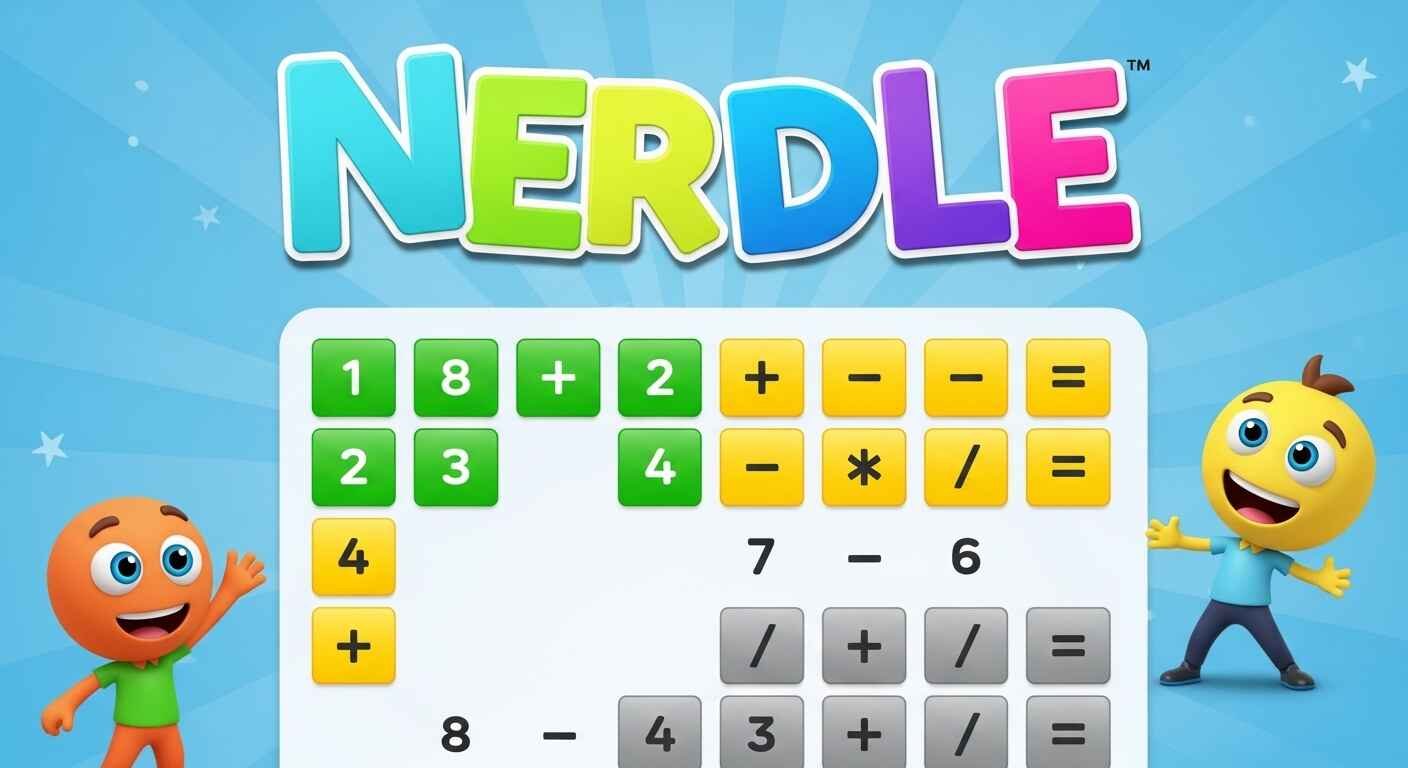
Nerdle is a free daily math puzzle game created by Richard Mann and launched in January 2022. It follows the same format as Wordle — six attempts to guess a hidden answer, with color-coded feedback after each guess — except instead of five-letter words, you’re working with eight-character mathematical equations.
A valid Nerdle equation might look like this:
3 + 5 × 9 = 48
Or this:
72 / 8 – 1 = 8
Your job is to figure out the hidden equation of the day using the color clues the game gives you after each guess. You have six attempts. The puzzle resets at midnight every day.
It sounds simple if you’re comfortable with math. The moment you sit down and try it, you realize the number of possible equations is enormous — and narrowing them down efficiently is a genuine skill.
Where to Play Nerdle
Official site: nerdlegame.com
Nerdle is completely free to play. No account required. No subscription. It works in any browser including on school Chromebooks and phones. A new puzzle appears every day at midnight and you can only play the daily puzzle — there’s no replaying yesterday’s equation.
The site also offers several variations of the game which are covered later in this guide.
Nerdle Game — Full Rules Explained
The Board
The Nerdle board is a 6×8 grid. Six rows represent your six attempts. Each row has eight cells — one for each character in the equation.
Valid Characters
Every equation you enter must use only these characters:
Numbers: 0 1 2 3 4 5 6 7 8 9
Operators: + − × /
Equals sign: =
That’s it. No letters, no brackets, no exponents in the standard version.
What Makes a Valid Guess
This is where Nerdle gets more complex than Wordle. Your guess must be a mathematically valid equation — not just any eight characters. Specifically:
- The equation must be mathematically correct. 3 + 5 = 9 is invalid because 3 + 5 = 8, not 9.
- The equals sign must appear in the equation. Every valid guess contains exactly one = sign.
- The result must appear on the right side of the equals sign. You cannot enter 9 = 3 + 6 even though it’s mathematically true — results go on the right.
- No leading zeros. You cannot enter 08 as a number — it must be 8.
- Standard order of operations applies. Multiplication and division are calculated before addition and subtraction. 2 + 3 × 4 = 14, not 20.
These constraints dramatically reduce the number of valid guesses — but they also dramatically reduce the number of possible hidden equations, which is what makes the puzzle solvable.
The Color Feedback System
After each guess, every cell changes color:
| Color | Meaning |
|---|---|
| 🟢 Green | Correct character in the correct position |
| 🟣 Purple | Correct character but in the wrong position |
| ⬛ Black | This character does not appear in the equation at all |
This is identical to Wordle’s feedback system — green means right place, purple means right character wrong place, black means not present.
The key difference from Wordle: characters in Nerdle aren’t just letters — they’re numbers, operators, and the equals sign. A purple 3 doesn’t just mean “3 is somewhere in the equation” — it means “3 appears somewhere other than this position, either as part of a number or on its own.”
How to Play Nerdle — Step by Step
Step 1: Go to nerdlegame.com. The daily puzzle loads automatically.
Step 2: Enter your first equation guess. Use the on-screen keypad or your physical keyboard. Type any valid eight-character equation — something like 1 + 2 + 3 = 6 or 9 × 8 – 4 = 68.
Step 3: Press Enter. The cells update with color feedback.
Step 4: Use the feedback to refine your next guess. Green cells are locked — keep those characters in those positions. Purple cells need to move — that character belongs somewhere else. Black cells eliminate that character entirely.
Step 5: Continue for up to six attempts. If you solve it in fewer, your streak continues. If you use all six without solving it, the equation is revealed and your streak resets.
Step 6: Share your result. Nerdle generates a shareable emoji grid — like Wordle — showing how many attempts you used and which rows had green, purple, and black cells. This is what people post on social media.
Nerdle Scoring — What Counts as a Good Result
| Attempts Used | Rating |
|---|---|
| 1 | Impossible luck — screenshot immediately |
| 2 | Exceptional — top tier solve |
| 3 | Excellent — better than most players |
| 4 | Good — solid consistent play |
| 5 | Average — room to improve |
| 6 | Made it — survival counts |
| Failed | The equation is revealed — streak resets |
Most experienced Nerdle players average between 3 and 4 attempts. Consistently solving in 3 puts you in a strong position. Getting it in 2 requires either remarkable strategy or fortunate starting guesses — or both.
Nerdle Strategy — How to Solve Every Puzzle Faster
This is where most Nerdle guides fall short. They tell you to “think mathematically” without explaining what that actually means in practice. Here’s the full breakdown.
Step 1 — Choose a Strong Opening Equation
Your first guess should maximize the information you receive. The goal is to test as many different characters as possible — specifically the most common characters in Nerdle equations.
The most frequently appearing characters in valid Nerdle equations are:
Most common numbers: 1, 2, 3, 4, 5, 6, 8, 9
Most common operators: + and −
Always present: =
This means your opening guess should ideally include several of the common numbers and at least one operator. Equations that test a wide spread of digits in a single valid guess give you the most information from your first attempt.
Strong opening equations to consider:
- 1 + 2 + 3 = 6 — tests three digits and the + operator across different positions
- 9 × 6 – 4 = 50 — tests multiplication, subtraction, and five different digits
- 36 / 4 – 1 = 8 — tests division and four different digits
- 5 × 7 + 3 = 38 — tests multiplication, addition, and four digits
Avoid opening equations that repeat the same digit multiple times — 2 + 2 + 2 = 6 tells you almost nothing useful because all three number cells test the same character.
Step 2 — Eliminate Operators Systematically
Nerdle equations contain exactly one or two operators in most cases. Your second and third guesses should systematically test operators you haven’t confirmed yet.
After your first guess, you know whether + or − or × or / appears in the equation based on the color feedback. Use your next guess to test the remaining untested operators wherever possible while maintaining equation validity.
Knowing which operators are present narrows the structure of the equation dramatically. A confirmed × significantly restricts which numbers make mathematical sense on each side.
Step 3 — Work Out the Equation Structure First
Before trying to pinpoint specific characters, figure out the structural template of the hidden equation. Templates look like this:
- N × N = NN (single digit times single digit equals two-digit number)
- NN + N = NN (two-digit number plus single digit equals two-digit number)
- N × NN − N = NN (three-operator equation with specific structure)
Once you know the structure — which positions hold single digits, which hold two-digit numbers, which hold operators — you’ve eliminated most of the possible equations and can focus on filling in the specific values.
Color feedback helps you deduce structure quickly. A green = in position 7 tells you the result is a single character. A purple = in position 7 means the = is somewhere else — probably position 6 — meaning the result is two digits.
Step 4 — Use Order of Operations as a Filter
Remember that Nerdle applies standard mathematical order of operations. This is your most powerful filtering tool and the one most players underuse.
If your feedback tells you the equation contains both × and +, multiplication happens first regardless of position. This constrains which number combinations produce valid results dramatically.
Example: If you know the equation is structured as N × N + N = NN and the result ends in 4, the number of valid equations is extremely small. List the multiplication results that can combine with a single digit addition to produce a two-digit number ending in 4. You’ll find maybe five or six valid options.
Step 5 — Treat the Right Side as Your Anchor
The right side of the equals sign — the result — is often the easiest part to solve first. Results in Nerdle equations are almost always one or two digits. A two-digit result appears in positions 7 and 8. A one-digit result appears in position 8 only, with the = in position 7.
Once you know the result or even just how many digits it has, you can work backwards. What operator combinations with what number ranges produce that result? This reverse-engineering approach is faster than guessing forward from the left side.
Step 6 — Eliminate Impossible Numbers Aggressively
Every black cell eliminates a character from the entire equation. Unlike Wordle where eliminating a letter rules out one type of character, eliminating a digit in Nerdle rules out that digit appearing anywhere — including as part of a two-digit number.
If 7 turns black, no 7 exists anywhere in the equation. This means any two-digit number containing 7 — 17, 27, 37, 47, 57, 67, 70, 71, 72, 73, 74, 75, 76, 78, 79, 87, 97 — is immediately ruled out. That’s a massive reduction in possible equations from a single piece of feedback.
Keep a running mental list of eliminated digits. By guess three or four, you’ll have ruled out enough numbers that only a handful of valid equations remain.
Nerdle Tips for Beginners
Always check your math before submitting. Nerdle rejects mathematically invalid equations — unlike Wordle which accepts any valid word. Double-check that your equation is correct before pressing Enter or you waste an attempt on an invalid guess.
Remember order of operations. This trips up new players constantly. 2 + 3 × 4 = 14, not 20. If your equation isn’t being accepted, check whether you’ve correctly applied multiplication and division before addition and subtraction.
The equals sign position tells you a lot. In an eight-character equation, the = can appear in positions 2 through 7. Its position tells you how many characters are on the left side and how many are on the right. A = in position 7 means a one-digit result. A = in position 6 means a two-digit result. This structural information is extremely valuable from your first guess.
Don’t avoid two-digit numbers. New players tend to guess equations with only single-digit numbers because they’re easier to verify mentally. But two-digit numbers appear in a large proportion of valid Nerdle equations. Avoiding them dramatically limits your search space.
Write it down. Seriously. Keep a notepad or open a notes app and track which digits and operators have been eliminated, which are confirmed, and which positions have been locked. Mental tracking works for Wordle’s 26 letters but struggles with Nerdle’s more complex feedback.
Use the commutative property carefully. 3 + 5 = 8 and 5 + 3 = 8 are both valid equations. If your feedback tells you 3 and 5 are present but in wrong positions, consider swapping them. This quick flip sometimes solves the puzzle in one move.
Nerdle Variations — All the Official Game Modes
The official Nerdle site offers multiple variations beyond the standard daily puzzle. Each one tests a different aspect of mathematical thinking.
Mini Nerdle
A shorter six-character equation instead of eight. Easier for beginners or for a quick daily puzzle when you don’t have time for the full version. Good starting point if the standard game feels overwhelming at first.
Micro Nerdle
Even shorter — five characters. The simplest version of the game. Equations look like 3×4=12 or 7+8=15. Recommended as a warm-up before tackling the standard puzzle.
Bi-Nerdle
Two Nerdle puzzles presented side by side simultaneously. You solve both at once — guesses apply to both boards at the same time. Significantly harder than the standard version and extremely satisfying when you crack both in four attempts or fewer.
Instant Nerdle
No color-coded feedback. Instead, the game tells you whether your answer is too high or too low — like a mathematical hot-and-cold game. Tests pure mathematical intuition rather than process-of-elimination logic.
Speed Nerdle
A timed version where you race against the clock rather than limiting attempts. Tests how quickly you can construct and verify valid equations under pressure. Good for competitive play between friends.
Classic Nerdle
The original eight-character daily puzzle with standard rules. This is the version most people mean when they say “Nerdle.”
Nerdle vs Other Daily Puzzle Games
How does Nerdle compare to the other daily games in this space?
| Game | Type | Skill Required | Difficulty | Daily Puzzle |
|---|---|---|---|---|
| Nerdle | Math equation | Math + logic | Hard | ✅ Yes |
| Wordle | Word guessing | Vocabulary | Easy–Medium | ✅ Yes |
| Letter Boxed | Word chaining | Vocabulary + spatial | Medium–Hard | ✅ Yes |
| Connections | Word grouping | General knowledge | Medium | ✅ Yes |
| Spelling Bee | Word building | Vocabulary | Hard | ✅ Yes |
| Tradle | Geography trade | Geography knowledge | Medium | ✅ Yes |
Nerdle is the hardest of the major daily puzzle games for players without a strong math background. For students who enjoy math, it’s the most rewarding — the sense of satisfaction when a complex equation clicks into place is unmatched by any word-based puzzle.
Nerdle Equation Examples — Common Structures to Know
Familiarising yourself with common equation structures makes your guesses more efficient. Here are the most frequent templates in Nerdle puzzles:
Single Operator Equations
NN + N = NN    e.g.  14 + 5 = 19
NN - N = NN    e.g.  23 - 8 = 15
N × NN = NN    e.g.  3 × 17 = 51
NN / N = NN    e.g.  48 / 6 = 8  (wait — that's one digit result)
Double Operator Equations
N + N × N = NN    e.g.  2 + 3 × 9 = 29
NN - N + N = NN   e.g.  15 - 3 + 4 = 16
N × N + N = NN    e.g.  4 × 7 + 2 = 30
NN / N - N = N    e.g.  18 / 3 - 2 = 4
Recognising these templates on sight means you can immediately test structural guesses rather than random equations. Once you’ve confirmed the template from two or three guesses, you’re filling in blanks rather than searching open space.
The Math Behind Why Nerdle Is Hard
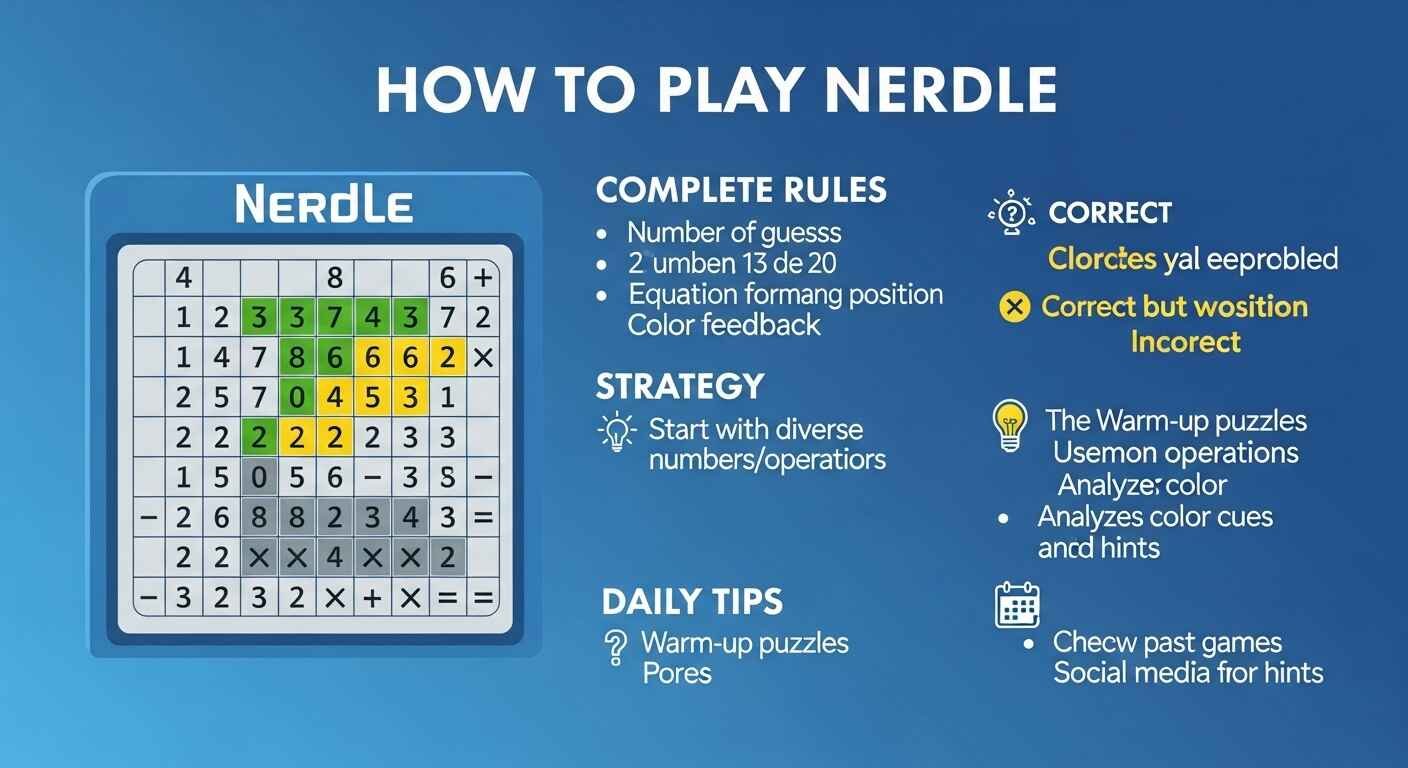
People who find Wordle easy often underestimate Nerdle because the concept sounds similar. Here’s why it’s genuinely harder:
More possible characters. Wordle uses 26 letters. Nerdle uses 10 digits plus 4 operators plus the equals sign — 15 characters total. More characters means more possible combinations.
Structural constraints are complex. In Wordle, any sequence of five letters can be a valid guess as long as it’s a real word. In Nerdle, your guess must be a mathematically valid equation — which is a much more restrictive constraint. This cuts down possible guesses significantly but also makes constructing useful guesses harder.
Order of operations changes meaning. Moving a character in a Nerdle equation doesn’t just change position — it can change the entire mathematical result. 2 × 3 + 4 = 10 but 2 + 3 × 4 = 14. Position matters differently than in word games.
Purple feedback is harder to use. In Wordle, a purple letter means “put this letter somewhere else.” In Nerdle, a purple digit means “this digit appears somewhere else in the equation” — but digits can be part of multi-digit numbers, which makes repositioning them much less straightforward.
Play Math and Puzzle Games Free at SyceGamesHack
Love the mental challenge of Nerdle but want more to play between daily puzzles? SyceGamesHack has 160+ free browser games including math games, puzzle games, and brain teasers all completely free, no download required, no ads, and fully accessible on school Chromebooks and any device.
Open the site, pick a game, and you’re playing in seconds. No sign-up. No payment. No ads. Ever.
Related Games You’ll Love
If you enjoy Nerdle, these are worth your time:
- Letter Boxed Game — the NYT daily word puzzle with similar chain-solving logic and daily reset
- Word Chain Game — fast word association that rewards quick thinking under pressure
- Imposter Game — social deduction word game with strategic bluffing
- Chameleon Game — one hidden player, one hidden word, unlimited tension
- Hashtag Game — creative prompt party game for when you need a break from solo puzzles
- MASH Game — the classic student favourite for zero-effort fun between study sessions
FAQs
Q: Is Nerdle free to play?
Yes. The daily Nerdle puzzle at nerdlegame.com is completely free. No account, no subscription, and no payment required. All game modes including Mini Nerdle, Micro Nerdle, and Bi-Nerdle are also free. The site is supported by advertising rather than subscriptions.
Q: How is Nerdle different from Wordle?
Both are daily guessing games with six attempts and color-coded feedback. Wordle uses five-letter words and 26 possible characters. Nerdle uses eight-character mathematical equations with 15 possible characters — 10 digits, 4 operators, and the equals sign. Nerdle applies mathematical validity rules that Wordle doesn’t have — your guess must be a correct equation, not just any combination of characters.
Q: Do I need to be good at math to play Nerdle?
You need to be comfortable with basic arithmetic — addition, subtraction, multiplication, and division and you must understand order of operations. You don’t need advanced mathematics, algebra, or anything beyond primary and early secondary school level. If you can verify that 6 × 7 – 3 = 39, you have all the math you need.
Q: What is order of operations and why does it matter in Nerdle?
Order of operations is the rule that multiplication and division are calculated before addition and subtraction regardless of their position in the equation. In Nerdle this matters because 2 + 3 × 4 equals 14 — not 20 — because 3 × 4 is calculated first. If your equation isn’t being accepted as valid, check whether you’ve applied order of operations correctly.
Q: Can the same digit appear more than once in a Nerdle equation?
Yes. A digit can appear multiple times in the same equation. For example 8 × 8 – 8 = 56 contains the digit 8 three times. This is different from Wordle where repeated letters create specific feedback rules — in Nerdle, repeated digits work the same way and the color feedback applies to each instance independently.
Q: What does a purple cell mean in Nerdle?
A purple cell means that character exists somewhere in the equation but not in that specific position. For a single digit like 5, it means 5 appears somewhere else in the equation. For an operator like +, it means + is present in the equation but in a different position. Purple feedback is harder to use in Nerdle than in Wordle because digits can be parts of larger numbers a purple 3 might mean 3 appears on its own or as part of 13, 30, 31, etc.
Q: Is there a way to play old Nerdle puzzles?
The official site does not offer an archive of past puzzles in the same way some Wordle archives do. However several fan sites and Nerdle archive tools have been built that let you play previous daily equations. Search “Nerdle archive” to find current options availability changes over time as the official site updates its policies.
Q: What is the hardest Nerdle variation?
Bi-Nerdle — where you solve two puzzles simultaneously with shared guesses is generally considered the hardest official variation. Each guess applies to both boards, meaning you must find equations that efficiently narrow down two different hidden equations at the same time. It requires holding significantly more information in your head simultaneously than any single-board variation.
Q: How many possible Nerdle equations exist?
The exact number depends on which characters and structural rules you count, but estimates place it in the tens of thousands of valid eight-character equations. This is far more than the roughly 2,300 possible Wordle answers which is part of why Nerdle requires more systematic strategy rather than just vocabulary recall.
Q: Can I play Nerdle on my phone?
Yes. The Nerdle website is fully mobile-optimised and works in any mobile browser. There is no dedicated app required just navigate to nerdlegame.com on your phone’s browser and the game loads and plays perfectly. It also works on school Chromebooks and any desktop browser.