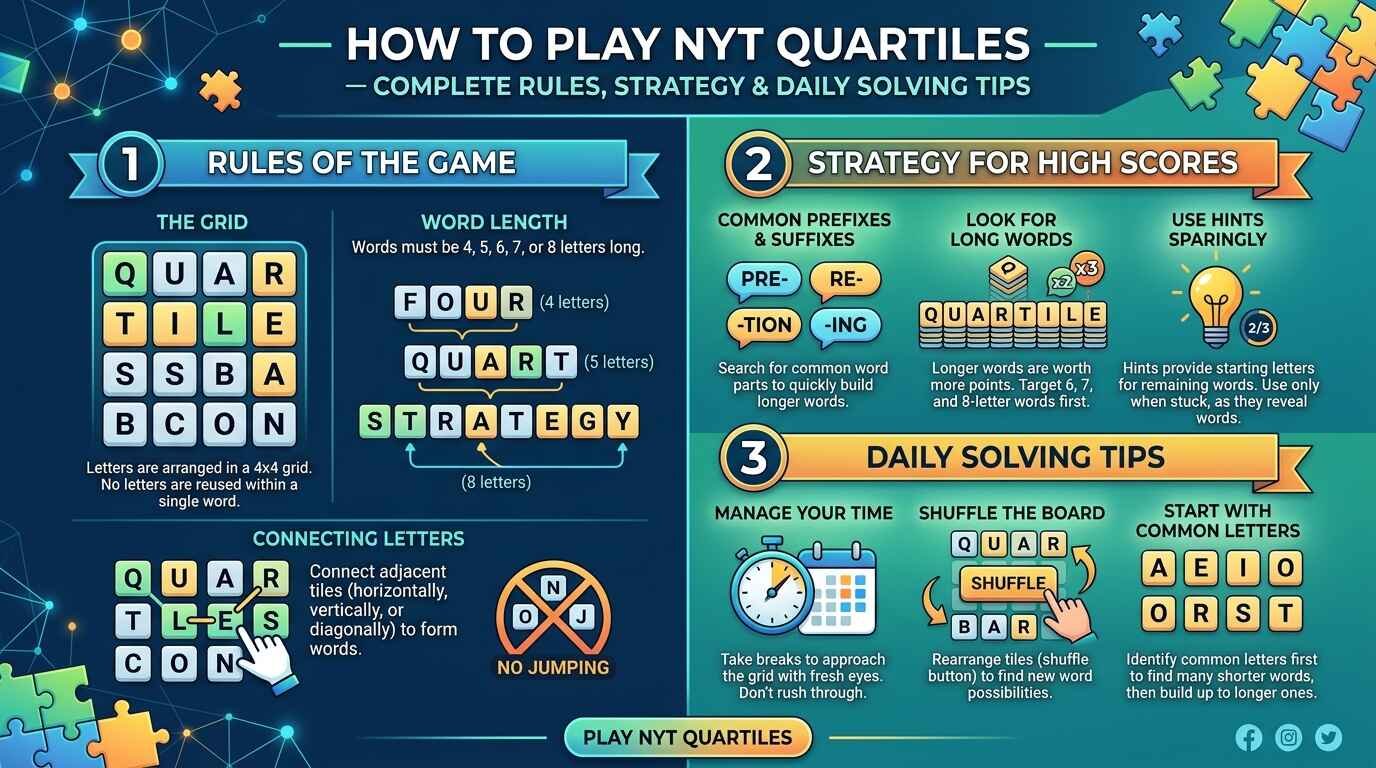
NYT Quartiles is the newest daily puzzle game from The New York Times — and it’s quietly becoming one of the most addictive in their lineup. Where Wordle tests vocabulary and Letter Boxed tests word-chaining logic, Quartiles tests something different entirely: your ability to see how word fragments fit together to form complete words.
The concept sounds deceptively simple. Twenty tiles sit on a five-by-four grid. Each tile contains a word fragment — a syllable or partial word. Your job is to combine exactly four tiles to form a complete word. Do that five times and you’ve solved the puzzle.
Sounds easy. The moment you sit down and stare at twenty fragments that seem to spell nothing obvious, you understand why millions of people spend their morning coffee on it.
This guide covers everything from scratch — the full rules, how scoring works, the solving strategies that experienced players actually use, and tips that will cut your solving time in half.
What Is the NYT Quartiles Game?
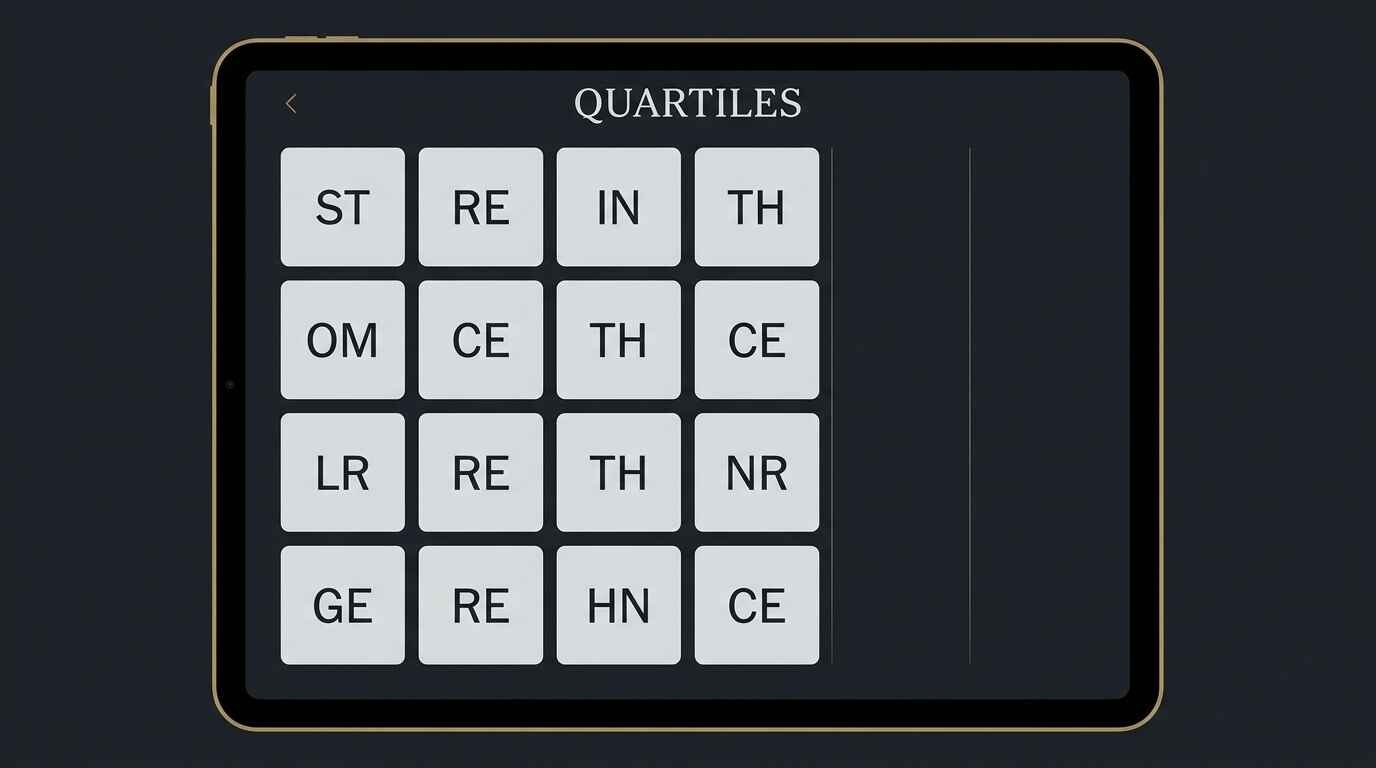
Quartiles is a daily word puzzle published by The New York Times Games. It was launched in 2024 and sits alongside Wordle, Connections, Letter Boxed, Spelling Bee, and the Mini Crossword in the NYT’s growing daily puzzle suite.
The game presents twenty word fragments arranged in a five-by-four grid. Players must combine groups of exactly four fragments to form complete words. The puzzle contains exactly five words — meaning all twenty tiles are used with nothing left over.
The challenge is that fragments can be rearranged in many ways that look plausible but aren’t correct, and the correct groupings aren’t always obvious from any individual tile. You have to see the puzzle holistically — how all twenty fragments relate to each other — rather than just focusing on one word at a time.
A new puzzle is released every day and the daily puzzle resets at midnight. Like all NYT daily games, your result is shareable via an emoji grid summary.
Where to Play Quartiles
Official site: nytimes.com/games/quartiles
Quartiles is available to New York Times Games subscribers. Unlike Wordle and the Mini Crossword which are free to non-subscribers, Quartiles sits behind the NYT Games subscription paywall. A NYT Games subscription costs a few dollars per month and gives access to the full puzzle library including Quartiles, Spelling Bee, and the Crossword.
The game is also accessible through the NYT Games app on iOS and Android.
Quartiles Game — Full Rules Explained
The Grid
The board is a five-by-four grid containing twenty tiles. Each tile holds a word fragment — typically one or two syllables. These fragments are scrambled across the grid with no obvious grouping or sequence visible at first glance.
A typical grid might contain fragments like:
BURG  |  ER   |  CHEES  |  HAM
---------------------------------
BACK  |  SAND  |  WICH   |  CLUB
---------------------------------
WICH  |  HOT   |  DOG    |  SUB
---------------------------------
ROLL  |  WRAP  |  BREA   |  KFA
---------------------------------
ST    |  TOAS   |  TED    |  LOAF
Somewhere in those twenty fragments are five complete words. Your job is to find all five.
The Core Rule — Groups of Exactly Four
Every word in Quartiles is formed by combining exactly four tiles from the grid. Not three, not five — always four. This is the non-negotiable structural rule of the game.
This means every complete word contains four tile-fragments arranged in sequence. The fragments themselves don’t need to be adjacent on the grid — you can select any four tiles from anywhere on the board.
Valid Words Only
The fragments must combine to form a real, dictionary-valid word. The NYT uses a standard English dictionary — proper nouns and abbreviations are generally not accepted.
All Twenty Tiles Must Be Used
This is the constraint that makes Quartiles genuinely challenging. Every single tile must be used in exactly one word. Nothing is spare. Nothing is left over. This means your five words together use all twenty tiles — four tiles per word, five words total.
This rule is your most powerful solving tool: if you’ve correctly identified four words, the remaining four tiles must form the fifth word regardless of whether you can immediately see it.
Hints and Stars
The game tracks your progress with a star rating:
- One star: You found a word using tiles that are already highlighted as grouped correctly — meaning the game is confirming you’ve found one of the five words
- No confirmation until submission: The game doesn’t tell you whether your four-tile combination is correct until you submit it — you tap the four tiles and then confirm
Some versions of the interface show partial confirmation feedback — tiles that are part of a correct group may highlight differently when selected together. Check the current interface when you play as the NYT updates presentation periodically.
How to Play Quartiles — Step by Step
Step 1: Open the Quartiles game at nytimes.com/games/quartiles. The twenty-tile grid loads automatically.
Step 2: Study the grid without clicking anything for thirty to sixty seconds. Look for obvious word fragments that seem to belong together. Notice fragments that look like beginnings, middles, or endings of familiar words.
Step 3: Tap or click four tiles you believe combine to form a complete word. The tiles highlight as you select them.
Step 4: When you’ve selected your four tiles, tap the submit button. If correct, those four tiles are marked as solved and removed from active play. If incorrect, the tiles deselect and you try again.
Step 5: Continue finding and submitting word groups until all five words are solved and all twenty tiles are marked complete.
Step 6: Your result screen shows how many attempts it took you to solve all five words. Share your result — the NYT generates an emoji summary grid similar to Wordle’s output — showing which words you found on which attempts.
Quartiles Scoring — How It Works
Quartiles doesn’t use a simple pass-fail system. It tracks your performance across attempts:
Attempt Tracking
Every time you submit a four-tile combination, it counts as an attempt regardless of whether it’s correct. Your final score reflects how many total attempts you used across all five words.
Attempt ratings — approximate benchmarks:
| Total Attempts | Performance |
|---|---|
| 5 attempts | Perfect — one correct submission per word |
| 6–8 attempts | Excellent — minimal incorrect guesses |
| 9–12 attempts | Good — solid solve with some trial and error |
| 13–18 attempts | Average — found all five eventually |
| 19+ attempts | Needs practice — lots of incorrect attempts |
Stars Rating
The game awards stars based on performance:
- 3 stars: Solved with very few incorrect attempts — essentially perfect or near-perfect play
- 2 stars: Solved with some incorrect attempts but strong overall performance
- 1 star: Solved — completion regardless of attempt count
Completion always earns at least one star. The star system rewards efficiency rather than just finishing.
Streaks
Like all NYT daily games, Quartiles tracks your daily completion streak. Completing the puzzle every day maintains your streak. Missing a day resets it. Your streak is displayed on your profile and in the sharing output.
Quartiles Strategy — How to Solve Every Puzzle
This is where most Quartiles guides stop at “look for common word parts.” That’s the beginning of the strategy, not the whole thing. Here’s the complete approach that experienced solvers actually use.
Step 1 — Scan for Anchor Fragments First
Before trying to build words, identify your anchor fragments — tiles that almost certainly belong to a specific word because they’re highly distinctive or uncommon.
Anchor fragments are typically:
- Very short tiles that look like specific prefixes or suffixes — UN-, RE-, -TION, -ING, -NESS
- Very unusual combinations that only fit one word — XYL-, PTER-, -BURGH
- Tiles that look like the unmistakable middle of a specific word — -OLOG- in “psychology” or -BURG in “hamburger”
Start your solving process from these anchors rather than from the obvious common fragments. Common fragments like -ER, -ED, -LY could belong to almost any word — they’re your last resort, not your starting point.
Step 2 — Think in Complete Words, Not Fragment Pairs
The most common beginner mistake is trying to pair fragments two at a time — finding AB + CD rather than thinking about the complete ABCD word. Pair-thinking leads to combinations that seem right but don’t form valid words.
Instead, hold a complete word in mind and then look for all four of its fragments simultaneously. Ask: “Is the word HAMBURGER in this puzzle?” Then look for HAM + BUR + G + ER rather than trying to build outward from one fragment.
This complete-word-first approach is dramatically more efficient than fragment-pairing.
Step 3 — Use the Twenty-Tile Constraint as a Filter
Remember: all twenty tiles must be used. This constraint is your greatest asset.
If you’ve confidently identified four words and they collectively use sixteen tiles, you don’t need to find the fifth word independently — the four remaining tiles tell you what it is. Simply read the four remaining fragments in sequence.
Even mid-solve, this constraint helps eliminate possibilities. If a fragment seems to belong to a word you’re considering but using it would leave another fragment stranded with no viable group, that word is wrong. Every tile must have a home.
Step 4 — Group Fragments by Sound Pattern
Look across all twenty tiles and mentally group fragments by their sound patterns. Fragments that share similar sounds or letter patterns often belong to words from the same semantic category — which hints at the puzzle’s hidden theme.
Most Quartiles puzzles have a loose thematic connection across all five words — foods, animals, sports terms, things in a kitchen. Identifying this theme early dramatically narrows which words the fragments are pointing toward.
Example: If you see fragments including SAND, CLUB, SUB, HOT, BUR, it’s reasonable to suspect the theme is “types of sandwiches or bread.” Now look for the remaining fragments that would complete those words — WICH for sandwich, HOT + DOG + ? for hotdog, and so on.
Step 5 — Solve Easiest Words First
Always submit your most confident word first. This removes four tiles from the active grid, making the remaining sixteen tiles easier to process visually.
Easier words give you confirmed tiles to work from. Once four tiles are marked solved, you know with certainty that none of them belong to the remaining words — which restricts your options and makes subsequent words easier to identify.
Step 6 — When Stuck, Work Backwards From Rare Fragments
If you’re stuck after finding two or three words, focus exclusively on the most unusual remaining fragments — the tiles that seem hardest to place into any word you can think of. These unusual fragments often point to the trickiest words in the puzzle that you’ve been unconsciously avoiding.
Common fragments like -ER, -ED, -AND can go almost anywhere and will fall into place naturally once the unusual fragments find their words. Solve for the unusual fragments and the common ones sort themselves out.
Step 7 — Read Fragments Aloud
When you’ve selected four tiles and you’re not sure if they form a valid word, read them aloud in sequence before submitting. Your ear often catches valid words that your eye misses — particularly compound words and multi-syllable words where the visual fragment breaks don’t match natural syllable breaks in speech.
Quartiles Tips for Beginners
- Give yourself the full sixty seconds at the start. Resist the urge to immediately start clicking tiles. The most efficient Quartiles solvers spend the first minute just looking — absorbing the full grid before committing to anything. Pattern recognition requires a full view of all twenty tiles simultaneously.
- Write the fragments down. Open a notes app and type all twenty tile contents in a list. Seeing the fragments in text form rather than grid form helps your brain process combinations differently. Some people find visual grid layouts create blind spots that text lists eliminate.
- Think about word length. Four tiles combine to form a word — that word is typically between six and twelve letters long. If your four-tile combination produces a two-letter word or a twenty-letter word, something is wrong. Words of seven to ten letters are the most common Quartiles answers.
- Don’t waste attempts on long-shot guesses. Every incorrect submission costs you stars. If you’re less than seventy percent confident a combination is correct, don’t submit it — keep thinking. The star rating rewards certainty over experimentation.
- Look for compound words and hyphenated words. Quartiles frequently uses compound words — words made of two smaller words joined together. Fragments like BACK + YARD, SUN + FLOW + ER + S, or WATER + FALL are common in compound-word puzzles. When you see fragments that look like complete small words, consider whether they might join with other small-word fragments.
- Accept that some puzzles are just hard. Every Quartiles player — including experienced daily solvers — hits puzzles where the theme or word choices are genuinely non-obvious. If you’re struggling after five minutes of solid effort, you’re not failing — you’re hitting a hard puzzle. Use your remaining attempts methodically rather than guessing randomly.
Common Quartiles Mistakes to Avoid
- Submitting unconfident guesses to “see what happens.” Unlike some games where experimental guesses cost nothing, every Quartiles submission reduces your star rating. Only submit when you’re genuinely confident.
- Ignoring the twenty-tile constraint. Players who focus on one word at a time often find themselves with four tiles remaining that form a bizarre non-word — because earlier “correct” words were actually wrong combinations that happened to be real words. Always track whether your current approach leaves all remaining tiles in viable groups.
- Assuming fragments always split at syllable boundaries. Sometimes tile breaks don’t match natural syllable breaks. CHEES + EBUR + GER + S might look odd visually but sounds like “cheeseburgers” immediately when read aloud. Don’t let visual fragment breaks override your phonetic reading of combinations.
- Treating the puzzle as five independent problems. Quartiles is one interconnected puzzle, not five separate word games. The fragments constrain each other. A choice about one word affects what’s available for all four others. Always think about how your current word choice affects the remaining tiles.
- Forgetting plural and verb forms. Many Quartiles words are plurals (-S), past tenses (-ED), or gerunds (-ING). If you can see four tiles that almost form a word but aren’t quite getting there, check whether one of the remaining unused tiles is a suffix that completes it.
Quartiles vs Other NYT Daily Games
How does Quartiles compare to the rest of the NYT games lineup?
| Game | Skill Tested | Difficulty | Time Required | Subscription |
|---|---|---|---|---|
| Quartiles | Fragment assembly | Medium–Hard | 5–15 mins | ✅ Required |
| Wordle | Word guessing | Easy–Medium | 2–5 mins | ❌ Free |
| Connections | Word grouping | Medium | 3–7 mins | ❌ Free |
| Letter Boxed | Word chaining | Medium–Hard | 5–15 mins | ❌ Free |
| Spelling Bee | Word building | Hard | 10–60 mins | ✅ Required |
| Nerdle | Math equations | Hard | 5–15 mins | ❌ Free |
| Mini Crossword | Crossword | Easy | 1–3 mins | ❌ Free |
Quartiles sits in the medium-hard range — harder than Wordle and Connections, comparable to Letter Boxed, and significantly less open-ended than Spelling Bee. It’s the most spatially oriented of the NYT puzzles because the tile grid adds a visual arrangement challenge on top of the word-finding challenge.
The subscription requirement is the most significant barrier compared to other NYT games. If you’re considering subscribing specifically for Quartiles, the NYT Games subscription includes Spelling Bee and the full Crossword archive which together provide substantial additional value.
Quartiles Themes — What to Expect
While the NYT doesn’t officially announce puzzle themes, experienced Quartiles players have identified common theme categories that appear regularly. Knowing these going into a puzzle helps calibrate your thinking:
Common Quartiles theme categories:
Food and Drink — Types of sandwiches, breakfast foods, cocktails, desserts, cooking methods Animals — Species names, animal groups, animal behaviors Sports and Games — Sport names, positions, equipment, game terminology Places — Cities, countries, geographical features Occupations — Job titles and professional roles Things in a category — Things in a kitchen, things at school, things at a beach Compound words — Two or three smaller words joined into one larger word Themed suffix words — Words all ending in the same suffix (-TION, -NESS, -OLOGY) Pop culture — TV show titles, movie genres, music terminology
When you first see a grid, scan for thematic hints. Three or four fragments that clearly relate to the same category often reveal the puzzle’s theme — which then guides your search for the remaining words.
How Quartiles Compares to Connections
Many players who enjoy Connections — the NYT’s word-grouping puzzle — find Quartiles a natural next step. The games share structural DNA: both involve grouping items into sets of four, and both hide the correct groupings within a larger set of options.
The key differences:
Connections groups whole words by hidden category. You see twenty-five words and find five categories.
Quartiles groups word fragments to form whole words. You see twenty fragments and find five complete words.
Connections tests general knowledge and lateral thinking — recognising surprising connections between words. Quartiles tests language processing and assembly — seeing how fragments combine into words. Players who love one often enjoy the other, and playing both daily creates a complementary vocabulary and language skill workout.
Play Free Puzzle Games at SyceGamesHack
Can’t access NYT Games right now? SyceGamesHack has 160+ free browser games — including word games, puzzle games, and brain teasers — all completely free, no subscription required, no download needed, and fully accessible on school Chromebooks, phones, and any desktop browser.
Zero ads. Zero downloads. Zero sign-up. Open the link and you’re playing in seconds.
Related Articles You’ll Love
- How to Play Letter Boxed — the free NYT daily word puzzle with chain-solving logic and daily reset
- Nerdle Game Guide — the daily math equation puzzle with the same six-attempt structure
- How to Play the Chameleon Game — social deduction word game for when you want live group play
- Imposter Game Generator — free word lists and roles for instant group gameplay
- Word Chain Game — fast word association with chain-building logic similar to Quartiles’ fragment assembly
- Jeopardy Game Maker — build your own word and trivia game for classroom or party use
- How to Play MASH Game — the zero-effort classic for between puzzle sessions
FAQs
Q: Is Quartiles free to play?
Quartiles requires a New York Times Games subscription — unlike Wordle and the Mini Crossword which are free. A NYT Games subscription gives you access to Quartiles alongside Spelling Bee, the full NYT Crossword archive, and other subscription-only games. Wordle, the Mini Crossword, and Connections remain free without a subscription.
Q: How is Quartiles different from Wordle?
Wordle asks you to guess a specific five-letter word in six attempts using color-coded letter feedback. Quartiles gives you twenty word fragments in a grid and asks you to group them into five sets of four fragments each — where each group forms a complete word. Wordle tests deduction from limited information. Quartiles tests word assembly from many available fragments. They’re both daily word games but the mechanics and skills are completely different.
Q: How many tiles form each word in Quartiles?
Always exactly four tiles per word. The puzzle contains exactly twenty tiles and exactly five words — four tiles per word times five words equals twenty tiles total. This is the non-negotiable structural rule of every Quartiles puzzle.
Q: What happens if I can’t solve Quartiles?
Unlike Wordle where the answer is revealed after six failed attempts, Quartiles allows unlimited attempts — your score simply reflects how many attempts you used. You can keep trying until you solve all five words regardless of how many incorrect submissions you make. The star rating decreases with more attempts but completion is always achievable.
Q: Can Quartiles fragments be used in multiple words?
No. Each of the twenty tiles belongs to exactly one word and can only be used once. Once you’ve correctly identified a word and its four tiles, those tiles are removed from active play. This constraint is what makes the puzzle solvable — if four tiles remain, they must form the final word.
Q: How long does it take to solve Quartiles?
Most players solve Quartiles in five to fifteen minutes. Experienced daily players who have developed pattern recognition can solve straightforward puzzles in under five minutes. Harder puzzles — where the theme is non-obvious or the word choices are unusual — can take twenty minutes or more even for experienced solvers.
Q: Does the order of fragments within a word matter?
Yes — fragments must be selected in the correct sequence to form the word. Selecting them in the wrong order produces a non-word even if all four fragments are correct. If your four tiles are correct but the submission fails, try reordering them before giving up on that combination.
Q: Is there a Quartiles archive for playing old puzzles?
The NYT does not officially provide a Quartiles archive for replaying old puzzles. Some community-built tools track past puzzles and allow replay — search for “Quartiles archive” to find current options. Availability changes as the NYT updates its content policies.
Q: What is the best strategy for a perfect Quartiles score?
Perfect play — five words found in exactly five submissions with no incorrect attempts — requires identifying all five words with certainty before submitting any of them. The most reliable approach is to fully solve the puzzle mentally before making your first submission. This takes longer upfront but eliminates all incorrect submissions. Most experienced players find a middle path — submitting their most confident words early and working through the harder ones with deliberate reasoning rather than guessing.
Q: How often does Quartiles release a new puzzle?
A new Quartiles puzzle is released every day at midnight Eastern Time — the same schedule as Wordle and all other NYT daily games. The puzzle resets daily and cannot be replayed after completion. Missing a day breaks your streak.
Q: Can I play Quartiles on my phone?
Yes. Quartiles is fully mobile-optimised and works in any mobile browser. The NYT Games app on iOS and Android also includes Quartiles alongside all other NYT Games subscription content. The touch interface works well for selecting and deselecting tiles.
Q: Is Quartiles harder than Connections?
Difficulty is subjective and varies by puzzle, but most players find Quartiles harder than Connections on average. Connections groups whole words by category — which tests general knowledge and lateral thinking. Quartiles requires assembling word fragments without knowing what words you’re looking for — which adds an additional layer of language processing difficulty. Players new to both games typically find Connections more immediately accessible.