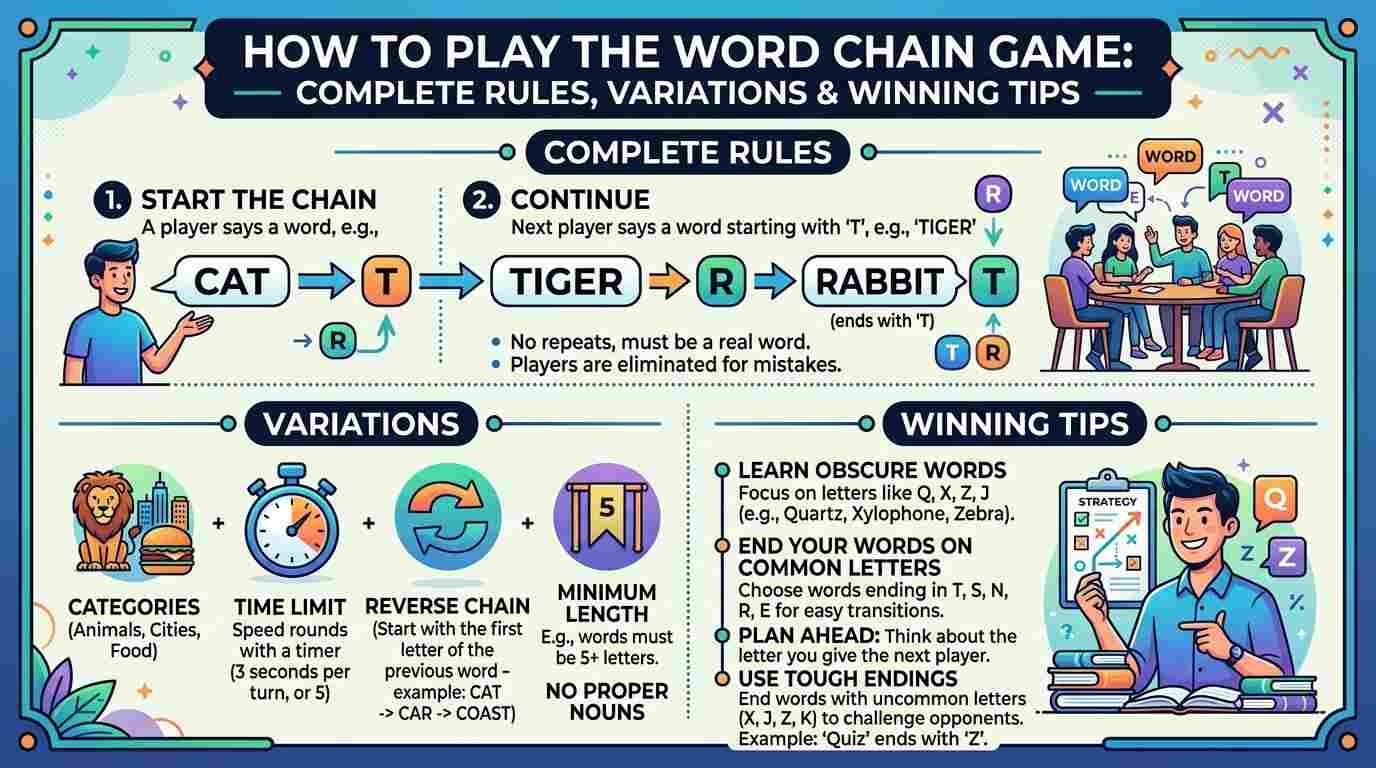
The Word Chain Game is one of those games that sounds almost too simple to be fun — and then forty minutes disappear and nobody wants to stop. One player says a word. The next player says a word starting with the last letter of that word. The chain keeps going until someone breaks it. That’s the whole game.
Except it isn’t, really. The moment you start playing seriously — under time pressure, with elimination stakes, using restrictive categories — it becomes a fast-paced mental workout that exposes exactly how quickly your brain can retrieve vocabulary under pressure. Some people are brilliant at it. Some people freeze on the letter X every single time. The gap between those two types of players is entirely closeable with the right strategy.
This guide covers everything: the full rules, every major variation worth playing, category ideas for different groups, tips that genuinely improve your performance, and where to play word chain games free online right now at SyceGamesHack.
What Is the Word Chain Game?
The Word Chain Game also called Word Links, Word Association Chain, or just Word Chain is a verbal word game where players take turns saying words that connect to the previous word by sharing its last letter as the new word’s first letter.
Player 1 says “elephant.” Player 2 must say a word starting with T “tiger.” Player 3 must say a word starting with R “rabbit.” Player 4 must say a word starting with T “tortoise.” Player 5 must say a word starting with E “eagle.”
The chain continues until someone hesitates too long, repeats a word already used, or says a word that doesn’t start with the correct letter. That player is out. The last player remaining wins.
Simple to explain. Genuinely difficult to play well under pressure.
What You Need to Play
- 2 or more players — works with any group size
- A timer — optional but recommended for competitive play
- Nothing else — no cards, no boards, no downloads, no paper
The Word Chain Game is one of the few games that works perfectly in any situation where you have a group of people and nothing else. Car rides. Waiting rooms. Lunch breaks. Queues. It fills time without requiring anything at all.
Word Chain Game — Full Official Rules
Rule 1: Choose a Starting Player and Word
The first player says any word to start the chain. This word can be anything — a noun, verb, adjective, animal, place, or object — as long as it’s a real word agreed upon by the group.
Optional starting rule: For a more level playing field, have the starting player say a word that ends in a commonly difficult letter — X, Q, U, or Z — so the second player immediately faces a challenge rather than an easy handoff.
Rule 2: Each Word Must Start With the Last Letter of the Previous Word
Every player’s word must begin with the final letter of the word just said. This is the core mechanic and the only connection rule in the standard version.
Example chain: Dog → Goat → Tiger → Rabbit → Toad → Dragon → Needle → Eagle → Eel → Lion
The chain above never breaks because each word starts with the correct letter. A player who says “lamp” after “lion” is wrong — lamp starts with L but lion ends in N, so the next word must start with N.
Rule 3: No Repeating Words
Once a word has been used in the chain, it cannot be used again in the same game. Players must track which words have already been said. In casual play this is done from memory. In competitive play someone can keep a written list.
Attempting to repeat a word — whether intentionally or not — results in immediate elimination.
Rule 4: Time Limit Per Player
Each player has a set amount of time to give their word. The standard time limit is 5 seconds for casual play and 3 seconds for competitive play. If a player hasn’t given a valid word when the time runs out, they are eliminated.
The timer can be kept by any player not currently in the hot seat — usually the person who just gave the previous word starts a mental count or uses a phone timer.
Rule 5: Elimination
A player is eliminated when they:
- Fail to give a word before the time limit expires
- Give a word that starts with the wrong letter
- Repeat a word already used in the chain
- Give a word the group agrees doesn’t exist
Eliminated players sit out for the rest of the round. They can rejoin at the start of the next round.
Rule 6: Last Player Standing Wins
Play continues with the surviving players until only one remains. That player wins the round. Start a new round — optionally with the winner going first and play to a set number of round wins or a point total.
Word Chain Game — Scoring Options
For casual play, just track round wins with no formal scoring. For longer sessions across multiple rounds, use one of these systems:
- Simple Win Scoring: Each round win earns 1 point. First to 5 points wins the match. Clean and easy to track.
- Survival Scoring: Players earn points equal to the number of opponents they outlast in each round. Outlasting 4 opponents earns 4 points. More competitive and rewards consistency across rounds.
- Streak Scoring: Players earn a bonus point for winning two rounds in a row, and two bonus points for three in a row. Encourages aggressive play to maintain streaks rather than safe conservative choices.
- Time Attack Scoring: Set a timer for 3 minutes. Count how many words the chain reaches before someone breaks it. The player who breaks the chain loses a point. The group’s goal is to collectively beat their previous record — cooperative scoring rather than competitive.
Best Word Chain Game Variations
The standard version is excellent. These variations add rules, restrictions, and twists that create dramatically different experiences.
Variation 1 — Category Word Chain
All words in the chain must belong to a specific category. The letter connection rule still applies — but words outside the category are invalid regardless of their starting letter.
Example with the category “Animals”: Cat → Tiger → Raccoon → Newt → Tarantula → Aardvark → Kangaroo
This variation is significantly harder than standard because you’re filtering vocabulary twice simultaneously — the right starting letter AND the right category. It works at any difficulty by adjusting how broad or narrow the category is.
Easy categories: Animals, Foods, Countries, Sports Medium categories: Things in a kitchen, Types of music, Movie titles Hard categories: Things smaller than a phone, Words with more than 8 letters, Names that start with a vowel
Variation 2 — Speed Chain
No individual time limit per player — instead, set a single timer for the entire chain. All surviving players must collectively get through as many words as possible before the timer expires. Anyone who pauses, repeats, or gives a wrong word is eliminated immediately and the chain continues with remaining players.
Best played in 90-second rounds. Creates frantic, high-energy gameplay where hesitation immediately costs you. Good warm-up game before moving to standard elimination rules.
Variation 3 — Alphabet Chain
Every word in the chain must start with the next letter of the alphabet in sequence — regardless of what letter the previous word ended with. Player 1 says any word starting with A. Player 2 says any word starting with B. Player 3 starts with C. And so on through to Z.
The connection is alphabetical rather than letter-linking. This variation tests vocabulary breadth across all 26 letters rather than quick retrieval from a single starting letter. Letters like Q, X, and Z become the genuinely tense moments where players freeze.
Example: Alligator → Banana → Candle → Diamond → Elephant → Frog → Guitar → Hammer → Igloo → Jacket → K ← often where it breaks
Variation 4 — Reverse Chain
Words must end with the first letter of the previous word rather than start with its last letter. The chain runs backwards.
Player 1: “Dog” — starts with D, ends with G Player 2 must say a word ending in D (the first letter of “Dog”) — “Speed” Player 3 must say a word ending in S (the first letter of “Speed”) — “Dress” Player 4 must say a word ending in D (the first letter of “Dress”) — “Road”
Reverse Chain requires players to think about word endings rather than beginnings — which is genuinely harder for most people. English speakers naturally categorize words by how they start, not how they end. Flipping that creates surprising difficulty even for strong word game players.
Variation 5 — No Ending Letters
Certain letters are banned as word endings. Common banned endings: S, E, D, N — the most common final letters in English. Any word ending in a banned letter immediately eliminates that player.
This forces players to choose words with unusual endings — X, K, P, W, F — which dramatically restricts the vocabulary available for the next player. Chains become very strategic as players deliberately choose words ending in difficult letters to trap the next player.
Example with S, E, D, N banned: Dog → Grab → Book → Kakapo → Ostrich → Help → …
Notice how each player has to think about not just connecting to the previous word but also not landing themselves — or the next player — in a trap.
Variation 6 — Two-Letter Jump
Instead of connecting on the last letter, players must connect on the last two letters. The next word must start with the final two letters of the previous word.
Player 1: “Elephant” — ends in NT Player 2 must start with NT — “Nteresting” ← Not a word. Player 2 is eliminated.
This variation is extremely difficult in standard English because very few common words share two-letter starts with common two-letter endings. Best played with a relaxed judging standard or used only as a party challenge variation rather than a competitive elimination game.
Variation 7 — Silent Chain
Same rules as standard — but no speaking allowed. Players write their words on paper or type them into a shared document. This removes the time pressure of verbal delivery and makes the game entirely about vocabulary rather than speed.
Silent Chain is excellent for large groups where people at the back can’t hear clearly, for playing over text message with remote friends, or for classroom settings where a quiet game is preferable.
Variation 8 — Word Chain Duel
Two players only — head to head. Standard rules apply but with a twist: the loser of each point must give the starting word for the next chain, giving the winner a slight advantage going into each new round. Best of 11 points wins the match. The most competitive format for Word Chain and surprisingly tense even between casual players.
Word Chain Category Ideas — 50 Ready to Use
- Animals Cat, Dog, Elephant, Shark — any creature from any kingdom
- Foods and Drinks Every type of food, cuisine, ingredient, or beverage
- Countries All 195 countries — trickier than it sounds when you hit Q and X
- Cities Any city worldwide — opens up global vocabulary
- Sports Every sport including obscure ones like curling and sepak takraw
- Movie Titles Any film title — single words only or full titles depending on your house rules
- Famous People’s First Names Real people only, first name only — historically famous or currently famous
- Things You Find at School Whiteboard, textbook, locker, cafeteria — school environment vocabulary
- Things in Nature Trees, rivers, mountains, weather phenomena, minerals
- Video Games Game titles only — enormous vocabulary for gaming groups
- Musical Instruments Guitar, piano, trumpet — harder than expected after the obvious ones go
- Colors Including shades and obscure color names — maroon, chartreuse, celadon
- TV Shows Any television show title — single words only for fairness
- Things in a House Every object, room, and fixture found in a home
- Occupations and Jobs Doctor, architect, plumber — all legitimate job titles count
- Things That Are Round Objects that are spherical or circular — eliminates most vocabulary immediately
- Words With More Than 6 Letters Instantly eliminates short easy words and forces longer vocabulary
- Things That Are Cold Conceptual category — ice, winter, freezer, Antarctica, tundra
- Adjectives Only No nouns, no verbs — pure descriptive words only
- Things You Can Buy at a Supermarket Enormous vocabulary that still has clear boundaries
- Mythological Creatures Dragon, phoenix, griffin, minotaur — good for fantasy-oriented groups
- Things That Move Cars, rivers, clouds, cheetahs — conceptual and surprisingly broad
- Words That Rhyme With the First Word The chain still uses last-letter connection but all words must also rhyme with the starting word — genuinely very hard
- Compound Words Only Sunflower, doorbell, butterfly, fireplace — single words that contain two words
- Things Smaller Than a Tennis Ball Marble, coin, grape, ant — surprisingly difficult to sustain beyond 10 words
- Word Chain Game Tips — How to Win Consistently
Most players approach Word Chain as a pure vocabulary test. It isn’t. It’s a strategy game dressed as a vocabulary test. These tips separate players who win rounds from players who just survive them.
Tip 1 — Pre-Load Hard Letter Responses
Before the game starts, spend 60 seconds mentally listing words for the hardest starting letters: Q, X, Y, Z, U, W. Most players freeze on these because they haven’t pre-loaded any responses.
Your Q list: Quick, Queen, Quiet, Quartz, Quill, Quiver, Quest, Queue Your X list: Xenon, Xylophone — that’s mostly it, which is why X is so dangerous Your Z list: Zebra, Zero, Zipper, Zombie, Zone, Zeal, Zenith Your Y list: Yellow, Yacht, Yak, Yarn, Yawn, Yogurt, Yolk
Knowing these cold means you never freeze on difficult letters while other players panic.
Tip 2 — Weaponize Your Word Endings
In standard Word Chain you control the starting letter for the next player. Use this deliberately. If the player after you is visibly struggling, end your word on their worst letter. If they froze on X two rounds ago, find a word ending in X.
Words ending in X: Fox, Box, Wax, Tax, Mix, Six, Fix, Hex, Flex, Flax, Jinx, Lynx, Onyx Words ending in Q: Iraq — almost nothing else in common English Words ending in Z: Jazz, Fizz, Buzz, Quiz, Fez, Topaz, Ritz
Building a mental arsenal of words with weaponizable endings is the single biggest competitive advantage in Word Chain.
Tip 3 — Avoid Common Trap Words
Some words seem like safe choices but consistently trap the player who says them. These are words ending in letters that have almost no common English words starting with them.
Words to avoid:
- “Iraq” — ends in Q, almost nothing starts with Q that most players know
- “Rhythm” — ends in M, fine — but players say it and then struggle on the next word
- “Sphinx” — ends in X, you’re setting up a trap for yourself on the next round
- Any word ending in U — “Menu,” “Tofu,” “Lieu” — very few common English words start with U
Unless you’re deliberately trying to trap the next player, stick to words ending in common starting letters: A, B, C, D, E, F, G, H, I, L, M, N, O, P, R, S, T.
Tip 4 — Build a Word Buffer, Not a Single Word
Beginners think of one word at a time. Winners maintain a buffer of three or four options for every starting letter they might face. When a word comes their way, they’re selecting from options — not searching from scratch.
When it’s not your turn, you have time. Use it. Look at the last letter of the current word in play and think of three words that start with it. Then look ahead — if the player before you says one of those words, what letter will you face? Pre-load that too.
Tip 5 — Keep Words Short Early
Short words give you more control over which ending letter you pass to the next player. “Cat” ends in T — huge vocabulary for the next player. “Caterpillar” ends in R — still good but less control. “Cat” takes one second to say and serves the same strategic purpose as any longer word.
Save long impressive words for when you need to buy yourself thinking time — a long word takes longer to say, giving you an extra half-second to find your next buffer word.
Tip 6 — Watch the Chain, Not Just Your Turn
Track the full chain, not just your individual words. Notice which letters have come up repeatedly — those letters have a shrinking pool of available words as the chain progresses and repeats accumulate. If “tiger” has already been said, T→R is gone. If “rabbit” is gone, R→T is gone. Knowing the depleted sections of the chain helps you avoid sending players toward letters with no remaining options — including yourself.
Tip 7 — In Category Chains, Own One Letter
If you’re playing Category Word Chain — say, Animals — identify one starting letter that has a deep animal vocabulary that other players are unlikely to know. Obscure animals starting with rare letters are your secret weapon.
Animals starting with rare letters:
- X: Xerus (an African squirrel)
- Q: Quoll (Australian marsupial), Quetzal (Central American bird)
- W: Wombat, Wolverine, Walrus, Warthog, Weevil, Woodpecker
- Z: Zebra, Zorilla, Zebu, Zander
Knowing these means you never freeze when the chain reaches a hard letter — and other players regularly do.
How to Play Word Chain Online — Free at SyceGamesHack
No group nearby? Word chain-style games are available free in your browser at SyceGamesHack — no downloads, no sign-up, no ads, and fully playable on school Chromebooks, phones, and any desktop browser. Browse 160+ free games across every genre including word games, party games, and multiplayer challenges.
You can also play Word Chain remotely with friends over video call — one person tracks the chain on screen while everyone plays verbally. It works perfectly over Zoom, Google Meet, or any video platform.
Word Chain Game for the Classroom
Word Chain is one of the best classroom games because it requires zero materials, works at any group size, and exercises genuine academic skills — vocabulary retrieval, spelling awareness, and quick thinking — without feeling like schoolwork.
How to run it as a classroom activity:
- Full class circle: Stand or sit in a circle. Standard rules apply. Any student who breaks the chain sits down. Last student standing wins. Works well as a 5-minute filler activity between lessons.
- Team competition: Divide into teams of four or five. Each team runs their own chain simultaneously. The team that sustains the longest chain without breaking it wins. The teacher tracks time for each team.
- Category review game: Set the category to match whatever subject is being studied. “Science vocabulary” for science class. “Countries we’ve studied” for geography. “Characters from the novel” for English. Word Chain becomes a vocabulary review activity that students actually enjoy.
- Alphabet chain for spelling practice: Run the alphabet variation with a spelling focus — words must be spelled out loud as they’re given. Any misspelling breaks the chain. Combines vocabulary retrieval with spelling accuracy.
- Written Word Chain for quiet time: Students pass a single piece of paper around a circle. Each student writes one word and passes it on. Silent, orderly, and still creates the same chain-building challenge.
Play Free Word and Party Games at SyceGamesHack
SyceGamesHack has 160+ free browser games available instantly no downloads, no sign-up, no ads. Word games, party games, puzzle games, and multiplayer games all in one place. Works perfectly on school Chromebooks, phones, tablets, and any desktop browser.
Zero ads. Zero downloads. Zero sign-up. Just open the link and play.
Related Games You’ll Love
If you enjoy Word Chain, these free games at SyceGamesHack are essential plays:
- Say the Word on Beat — word categories under rhythm pressure — the fastest-paced word game on this list
- Letter Boxed — the NYT daily puzzle where words must chain by letter — the closest digital cousin to Word Chain
- Chameleon Game — one-word clues, social deduction, hidden roles — same vocabulary pressure with added bluffing
- Hashtag Game — creative word matching for groups — excellent follow-up to Word Chain for party nights
- Imposter Game — strategic one-word clues where one player is hiding — word game meets social deduction
- Nerdle Game — if Word Chain is your warm-up, Nerdle is the math equivalent daily challenge
- MASH Game — the zero-pressure classic for when your brain needs a rest after Word Chain
FAQs
Q: How many players do you need for the Word Chain Game?
Word Chain works with as few as 2 players — head-to-head duel format is surprisingly tense and competitive. The sweet spot for group play is 4 to 8 players, where elimination rounds have enough players to create tension without rounds ending too quickly. With larger groups of 10 or more, team formats or the Speed Chain variation work better than individual elimination.
Q: What counts as a valid word in Word Chain?
Any real word in the agreed-upon language counts as valid — nouns, verbs, adjectives, adverbs, and proper nouns depending on your house rules. Common house rule variations include: proper nouns allowed (Paris, Einstein, Beyoncé count), proper nouns not allowed (only common dictionary words), or category-restricted (only animals, only foods, etc.). Set your rule before the game starts and apply it consistently throughout.
Q: What happens if players disagree about whether a word is real?
The most common house rule is majority vote — if more than half the group thinks the word isn’t real, it’s disallowed and the player is eliminated. A fairer rule for competitive play is the dictionary check — any disputed word gets looked up immediately, and the result stands. Decide your dispute resolution rule before the game starts to avoid arguments mid-chain.
Q: Can you use the same root word in different forms?
This varies by house rule. Some groups allow “run,” “running,” and “runner” as separate valid words. Others count any shared root as a repeat and disallow them. The stricter rule — no related forms of the same root — makes the game harder and is recommended for experienced groups. The looser rule works better for younger players or casual sessions.
Q: What is the hardest letter to start a word with in Word Chain?
X is almost universally the hardest letter to start a word with in English. The most common X-starting words — xylophone, xenon, xerox — are known by most players, making the pool depleted very quickly. Q is similarly difficult. Z, W, and U are moderately hard. A, B, C, S, and T are the easiest starting letters with the largest available word pools.
Q: How long should the time limit be per player?
Five seconds is the standard casual time limit — enough time to think but short enough to create pressure. Three seconds is competitive play — most experienced players use this. For younger players or beginners, ten seconds is more appropriate. For an extreme challenge, use two seconds — which basically requires players to have pre-loaded their response before their turn arrives.
Q: Can you play Word Chain over text message?
Yes — Word Chain works well asynchronously over text message, messaging apps, or social media. Simply apply the same rules but without a time limit — each player has until the next person responds. The no-repeat rule is easily managed since the full chain is visible in the message thread. This format is slower but enjoyable for groups who can’t play in real time.
Q: Is Word Chain good for language learning?
Excellent — it’s one of the best vocabulary-building activities for language learners because it forces rapid retrieval across the full range of vocabulary rather than just the words you happen to think of in normal conversation. It surfaces gaps in vocabulary quickly — the letters you freeze on reveal exactly which areas of vocabulary need more work. ESL teachers frequently use Word Chain as a classroom activity for this reason.
Q: What is the longest recorded Word Chain?
No official record exists for casual play, but competitive word chain communities have documented chains exceeding 500 words in timed sessions. In standard casual play, chains of 50 to 100 words before a break occurs are considered strong performances for a group of four or more players.
Q: How is Word Chain different from Word Association?
Word Association has no letter connection rule — players say any word that mentally connects to the previous word (Dog → Bone → Skeleton → Halloween). Word Chain has a strict letter connection rule — each word must start with the last letter of the previous word regardless of meaning. Word Chain is more structured and has clearer win conditions. Word Association is more freeform and better for creative or therapeutic use.