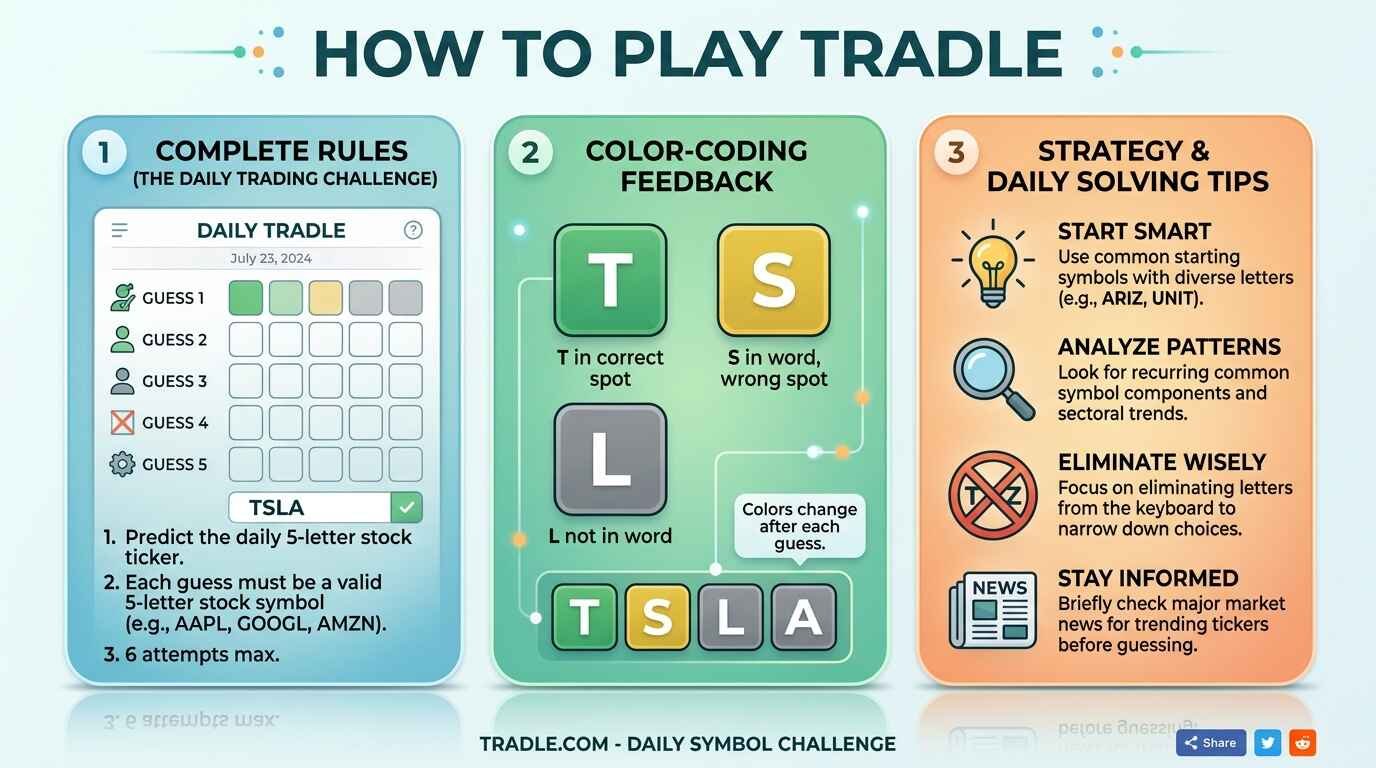
Tradle is the geography version of Wordle — and it’s genuinely one of the most original daily puzzle games on the internet. Instead of guessing a word or solving an equation, you’re looking at a chart of a country’s exports and trying to figure out which country it belongs to. You get six attempts. After each wrong guess the game tells you how far away you are and which direction to look.
It sounds niche. The moment you sit down and stare at a treemap of coloured export rectangles — some labelled, some cryptically categorised — and try to narrow down which of 195 countries it could be, you understand immediately why geography enthusiasts, economics students, and general knowledge addicts are completely hooked on it.
This guide covers everything from scratch — what Tradle is, how the export chart works, the full rules, how distance feedback translates into strategy, and the solving techniques that experienced players use to consistently crack puzzles in three attempts or fewer.
What Is the Tradle Game?
Tradle is a free daily geography puzzle game created by a developer named Lars Vedo and launched in early 2022. It was directly inspired by Wordle but replaces letter-based word guessing with country-based geography guessing.
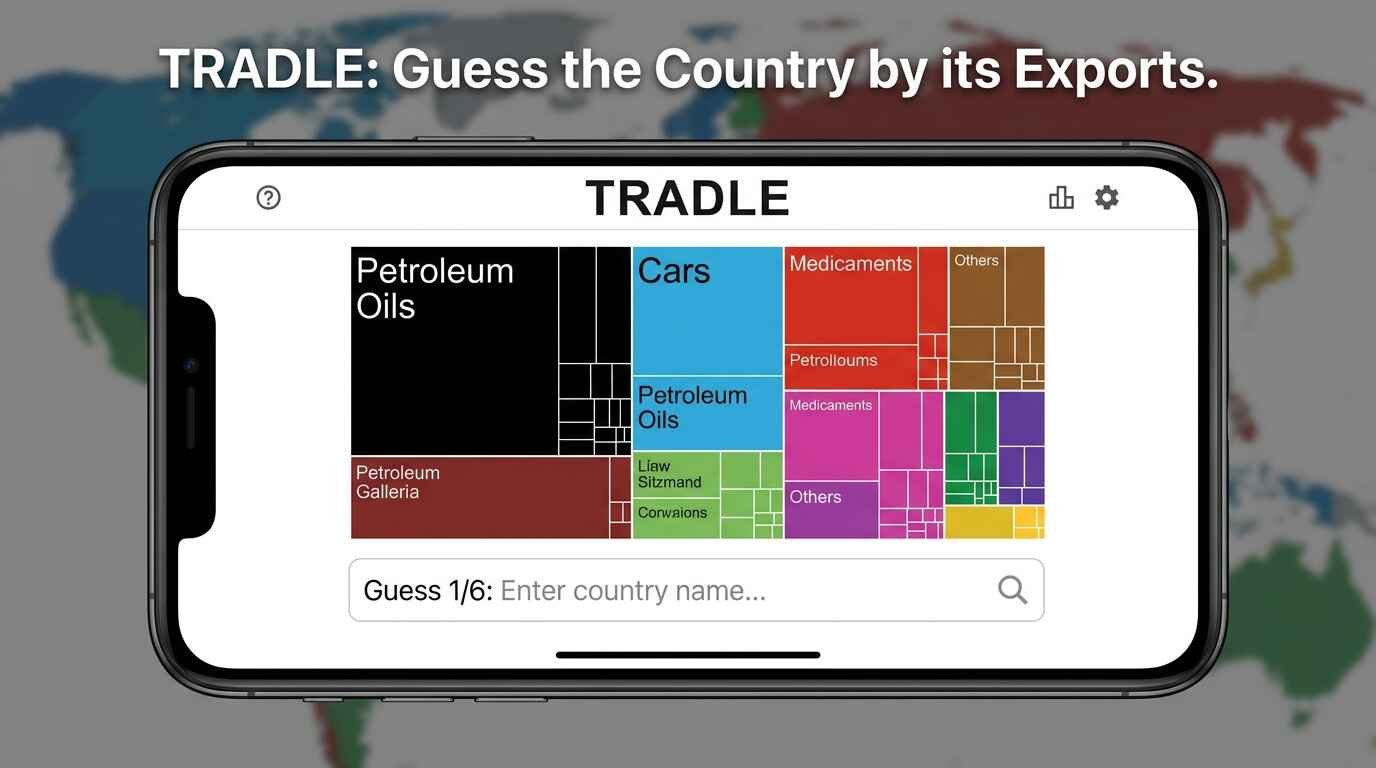
Every day a new country is selected as the hidden answer. The game displays that country’s export data as a treemap — a visual chart where each rectangle represents a category of exports, sized proportionally to how much of that country’s total exports that category represents.
Your job is to identify the country from its export profile alone. You type a country name as your guess, and the game tells you how many kilometres away your guess is from the correct answer — and which compass direction to look. Use that distance and direction feedback to narrow down your next guess. Six attempts to get it right.
A new puzzle resets every day at midnight. Your result is shareable as an emoji summary — distance arrows and a flag reveal — that players post on social media alongside their Wordle and Letter Boxed results.
Where to Play Tradle
Official site: oec.world/en/tradle
Tradle is completely free. No account required. No subscription. It works in any browser including on school Chromebooks and phones. The game loads instantly and a new puzzle appears every day.
The game is built on data from the Observatory of Economic Complexity — a genuine economics research platform from MIT that tracks global trade data. The export charts you see in Tradle are real, accurate economic data from that research database.
Understanding the Tradle Export Chart
Before the rules make complete sense, it helps to understand what you’re actually looking at when Tradle loads.
What Is a Treemap?
A treemap is a type of data visualisation where categories are shown as rectangles. Bigger rectangles represent larger proportions of the total. The entire chart represents 100% of the country’s exports — every rectangle is a slice of that total.
In Tradle’s treemap each top-level rectangle represents a major export category — things like Machinery, Mineral Products, Vegetable Products, Precious Metals, Textiles, and so on. Within each large rectangle, smaller rectangles show subcategories — so within “Mineral Products” you might see “Crude Petroleum,” “Refined Petroleum,” and “Natural Gas” as separate sub-rectangles.
What the Colours Mean
Tradle uses a consistent colour coding system across all puzzles:
| Colour | Export Category |
|---|---|
| 🔵 Blue | Machinery and mechanical equipment |
| 🟤 Brown/Orange | Mineral products (oil, gas, coal) |
| 🟢 Green | Vegetable products and food |
| 🔴 Red/Pink | Chemical products |
| 🟡 Yellow/Gold | Precious metals and stones |
| 🟣 Purple | Textiles and clothing |
| Light Blue | Transportation equipment |
| Olive/Dark Green | Wood and paper products |
| Teal | Metals (base metals) |
| Pink/Light Red | Plastic and rubber products |
These colours appear consistently across all puzzles. Learning them means you can immediately read the overall export profile of a country at a glance — oil-heavy economy, manufacturing economy, agricultural economy, and so on — without reading any labels.
What’s Labelled vs What’s Not
The treemap labels its largest rectangles but leaves smaller ones unlabelled — they’re simply too small to fit text. This creates the challenge. A large blue machinery rectangle tells you clearly that machinery is a major export. A tiny unlabelled yellow sliver requires inference — it’s probably precious metals or stones based on the colour, but you can’t be certain of the specific subcategory.
This partial information is deliberate. The puzzle isn’t about reading a complete economic report — it’s about reading enough of the profile to narrow down the country.
Tradle Game — Full Rules Explained
The Starting Position
When you open Tradle, you see:
- The treemap export chart for the hidden country — no country name, no flag, no other identifying information
- A text input box to type your guess
- Six attempt slots below the input — currently empty
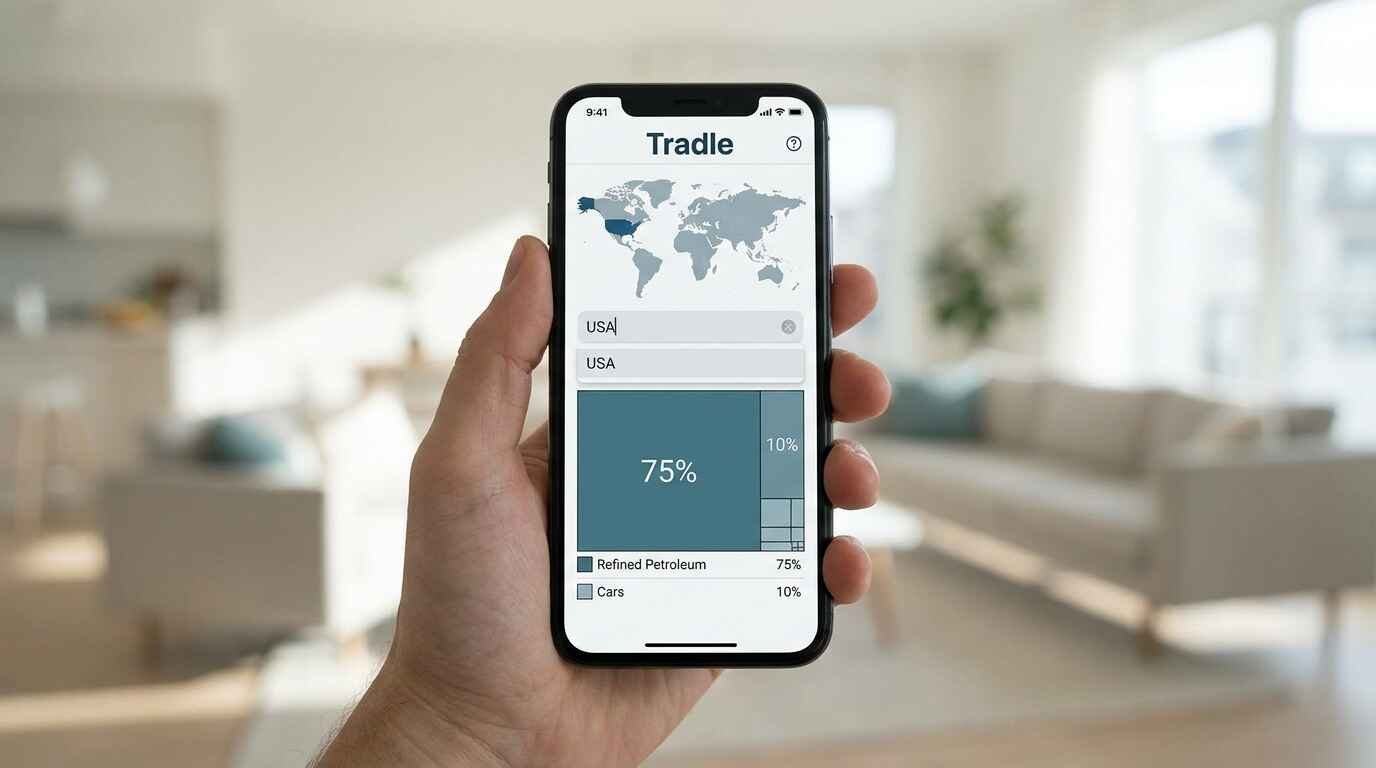
- A percentage breakdown of major export categories listed alongside the treemap
The percentage breakdown is particularly useful — it lists the top export categories with their exact percentage of total exports. This gives you precise data to work with even for categories too small to read clearly on the treemap itself.
Making a Guess
Type any country name into the input box and select it from the dropdown that appears. Tradle recognises all 195 UN-recognised countries plus several territories. If your spelling is close, the autocomplete usually finds what you’re looking for.
Submit your guess by pressing Enter or clicking the submit button.
Reading the Feedback
After each wrong guess, Tradle gives you three pieces of information:
Distance: How many kilometres away your guessed country is from the correct answer — measured from the geographic centre of each country. This is your most valuable feedback. A distance of 500km means you’re very close geographically. A distance of 15,000km means you’re essentially on the opposite side of the planet.
Direction: A compass arrow showing which direction from your guess the correct answer lies. North, Northeast, East, Southeast, South, Southwest, West, or Northwest. Combined with distance this tells you a precise search zone on the map.
Proximity Percentage: A percentage score from 0% to 100% showing how close your guess was. 100% means correct. Higher percentages mean you’re geographically closer. This is essentially a visual representation of the distance feedback but expressed as a warmth score.
Winning and Losing
Guess the correct country within six attempts and you win. If all six attempts are wrong, the game reveals the correct answer — its flag, its name, and its full export breakdown. Your streak resets.
Like all daily games, you can only play the current day’s puzzle. There’s no replaying after completion.
How to Play Tradle — Step by Step
Step 1: Open oec.world/en/tradle. The export treemap loads automatically.
Step 2: Study the treemap for thirty to sixty seconds before guessing. Look at the dominant colours, the proportional sizes of major categories, and the specific subcategories you can read in the labels.
Step 3: Form a hypothesis about what type of economy this is — oil-exporting nation, manufacturing powerhouse, agricultural economy, mining-focused economy. This hypothesis guides your first guess.
Step 4: Type your first guess — ideally a country that fits your economic hypothesis and sits in a geographically central position on the world map. Submit.
Step 5: Read the distance and direction feedback. Update your mental map of where the correct country could be.
Step 6: Make your second guess based on the constrained search zone the feedback defines. Continue narrowing down with each attempt until you solve the puzzle or exhaust your six guesses.
Step 7: Share your result. The emoji summary shows your attempt count and the direction arrows from each guess — a clean visual record of how you narrowed down the answer.
Tradle Scoring — What the Numbers Mean
| Attempts | Rating |
|---|---|
| 1 attempt | Exceptional — either expert knowledge or fortunate first read |
| 2 attempts | Excellent — strong economic and geographic reasoning |
| 3 attempts | Great — above average daily performance |
| 4 attempts | Good — solid solve with efficient narrowing |
| 5 attempts | Average — got there with plenty of attempts |
| 6 attempts | Survival — completion is still a win |
| Failed | The country is revealed — streak resets |
Most experienced daily Tradle players average between three and four attempts. Consistently solving in two attempts requires both strong geography knowledge and sharp economic pattern recognition. A first-attempt solve usually involves recognising a very distinctive export profile — a country whose economy is so uniquely structured that nothing else could match it.
Tradle Strategy — How to Solve Every Puzzle
Step 1 — Read the Export Profile Before Guessing Anything
Never guess immediately. Spend at least thirty seconds reading the treemap before your first attempt. You’re looking for four things:
- Dominant export category: What takes up the most space? A chart dominated by brown/orange mineral products immediately suggests an oil or gas exporting nation. A chart dominated by blue machinery suggests a developed industrial economy. A chart dominated by green vegetable products suggests an agricultural economy.
- Secondary categories: The second and third largest rectangles tell you what kind of economy exists alongside the primary export. Oil nations with significant machinery exports might be more developed than pure petrostates. Agricultural nations with significant precious metals suggest Sub-Saharan Africa or South America.
- Diversity vs concentration: Is the chart dominated by one massive rectangle, or is it spread across many roughly equal categories? Highly concentrated export economies — where one category is 60%+ of all exports — are usually either petrostates or mining-dependent developing nations. Diverse export economies suggest developed industrial nations.
- Specific subcategories visible in the labels: Can you read any specific subcategory labels inside the major rectangles? “Crude Petroleum” as a readable subcategory tells you far more than just “Mineral Products” — crude oil exporters are a specific subset. “Coffee” visible in a green food category immediately suggests a handful of countries. Read every label you can make out.
Step 2 — Classify the Economy Type First
Before thinking about specific countries, classify what type of economy you’re looking at. This narrows your search from 195 countries to a much smaller relevant group.
Economy type classifications:
- Petrostate: 50%+ mineral products, predominantly crude petroleum. Likely Middle East, Central Asia, West Africa, or Venezuela. Examples: Saudi Arabia, Kuwait, UAE, Nigeria, Iraq, Azerbaijan.
- Developed manufacturing economy: Large blue machinery sector, diverse exports, significant chemical and transportation equipment. Likely Western Europe, East Asia, or North America. Examples: Germany, Japan, South Korea, United States, France.
- Agricultural economy: Large green vegetable products sector, limited manufacturing, possible food processing. Likely Sub-Saharan Africa, Southeast Asia, or South America. Examples: Ethiopia, Ivory Coast, Honduras, Myanmar.
- Mining economy: Large share of precious metals, base metals, or mineral ores. Likely Sub-Saharan Africa, South America, or Australia. Examples: Democratic Republic of Congo, Zambia, Chile, Peru, Australia.
- Textile economy: Large purple textile sector often combined with some manufacturing. Likely South Asia or Southeast Asia. Examples: Bangladesh, Cambodia, Pakistan, Vietnam.
- Financial and service economy: Very small overall trade footprint with unusual balance of financial services — Tradle sometimes shows financial centres with small but distinctive export profiles. Examples: Luxembourg, Singapore, Switzerland.
Step 3 — Use Your First Guess Geographically
Once you’ve classified the economy type, your first guess should serve a dual purpose: testing your economic hypothesis AND providing maximum geographic information regardless of whether it’s correct.
The best first guesses for Tradle are countries in the geographic centre of your suspected region. If the economy looks like a Sub-Saharan African agricultural nation, guessing a central African country like the Democratic Republic of Congo or Cameroon gives you direction feedback that covers the entire continent efficiently — whether the answer is in West Africa, East Africa, or Southern Africa.
Avoid guessing island nations or geographically extreme countries as your first guess — they’re located at the edges of regions and give you direction feedback that points you away from or into open ocean rather than toward a search zone full of candidate countries.
Strategic opening guesses by suspected region:
| Suspected Region | Good Opening Guess | Why |
|---|---|---|
| Middle East / North Africa | Saudi Arabia | Geographic centre of oil-rich zone |
| Sub-Saharan Africa | Democratic Republic of Congo | Central location covers entire continent |
| Southeast Asia | Thailand | Central location between all major SE Asian economies |
| South America | Brazil | Massive country covers most directional scenarios |
| Western Europe | Germany | Central Europe covers most regional directions |
| Central Asia | Kazakhstan | Enormous country, central position |
| East Asia | China | Central position, diverse economy for comparison |
| Caribbean / Central America | Mexico | Northern anchor of Latin American region |
Step 4 — Apply Direction and Distance Feedback Precisely
After your first guess, you have a distance in kilometres and a compass direction. Apply these together to define your search zone.
Distance interpretation:
- Under 1,000km — neighbouring countries or the same country
- 1,000–3,000km — same regional cluster, nearby subregion
- 3,000–6,000km — same continent or adjacent continent
- 6,000–10,000km — different major world region
- Over 10,000km — nearly opposite side of the world
Direction interpretation: Apply the compass direction from your guessed country’s geographic centre. If you guessed Brazil and the feedback says “Northeast, 8,500km” draw a northeast line from Brazil 8,500km and see what lies there. That search zone lands you in Western Europe or North Africa.
The combination of both pieces of feedback defines a relatively small geographic zone by your second guess. Within that zone, apply your economic type classification to identify the most likely candidate countries.
Step 5 — Eliminate Systematically With Each Guess
By guess three or four, your search zone should be small enough that you’re choosing between five to ten candidate countries. Use your economic profile reading to eliminate them systematically.
Ask of each remaining candidate: does this country’s known economy match the treemap I’m looking at? If the treemap shows a heavy textile component and you’re narrowed to Southeast Asia, Bangladesh is more likely than Singapore. If the treemap shows significant precious metals alongside agricultural products and you’re narrowed to East Africa, Tanzania is more likely than Kenya.
You don’t need to be an economics expert to apply this filtering — most major export profiles are identifiable from general geography knowledge. Oil countries, coffee countries, diamond countries, textile countries — these are well-known enough that general knowledge provides significant filtering power.
Step 6 — Use the Percentage Breakdown as Your Precision Tool
The percentage breakdown listed alongside the treemap is your most precise data source. When you’re narrowed to a few candidates and need to pick between them, compare the specific percentages to what you know about each candidate country’s economy.
If the breakdown shows “Machinery 45%, Vehicles 18%, Chemical Products 12%” — that profile matches Germany or Japan far more closely than it matches France or South Korea. Small differences in the percentages can distinguish between otherwise similar economies.
Tradle Tips for Beginners
- Learn the colour coding before your first game. Spending five minutes learning which colours represent which export categories pays dividends immediately. Brown/orange for mineral products, blue for machinery, green for agricultural — these three alone cover the majority of world trade and let you classify any economy’s type at a glance.
- Start with a geography anchor, not a specific guess. Your goal in the first two attempts is to define the search zone, not guess the answer. Choose geographically strategic opening guesses that give you maximum directional information regardless of whether they’re correct.
- Read the percentage breakdown carefully. The text list alongside the treemap contains precise data that the visual chart can only approximate. Cross-reference the visual impression with the specific percentages — they sometimes contradict each other in informative ways.
- Know your petrostates. Oil-dominated economies are the most distinctive and common Tradle puzzles. Knowing the major oil-exporting nations by heart — Saudi Arabia, UAE, Kuwait, Iraq, Iran, Nigeria, Libya, Angola, Venezuela, Kazakhstan, Azerbaijan — means you can identify petrostate puzzles within your first guess and solve them in two or three attempts reliably.
- Know your textile economies. The next most distinctive and common profile is heavy textile exports. The major textile exporters — Bangladesh, Cambodia, Vietnam, Pakistan, Sri Lanka — are a small enough group that identifying a textile-heavy profile immediately narrows you to five strong candidates.
- Brush up on regional geography before playing. The direction feedback is only useful if you know roughly where countries are relative to each other. Players with strong mental maps of world geography have a significant advantage. If geography isn’t your strength, a few minutes reviewing a world map before your first game is worthwhile investment.
- Don’t panic on unusual profiles. Some Tradle puzzles feature small nations with genuinely strange or highly specific export profiles — landlocked countries exporting electricity, island nations with aquaculture-heavy profiles, micro-states with financial service footprints. These are harder puzzles and require more attempts. Unusual profiles are features of genuinely unusual economies — embrace the learning.
Tradle Tips for Experienced Players
Build a mental library of distinctive export profiles. After a few months of daily play, experienced Tradle players develop strong pattern recognition for distinctive national profiles. Some are nearly instantly recognisable:
- Overwhelming crude petroleum with almost nothing else → Kuwait or Libya
- Large diamonds rectangle in precious metals → Botswana or Democratic Republic of Congo
- Very large coffee subcategory in green food → Ethiopia or Vietnam
- Significant cocoa within food products → Ivory Coast or Ghana
- Copper dominating base metals → Zambia or Chile
- Very large gold percentage → Ghana, Mali, or Papua New Guinea
- Heavy cut flowers in agricultural → Kenya or Ethiopia
- Significant uranium in mineral products → Kazakhstan or Niger
Track the answer patterns. Tradle occasionally revisits certain countries more frequently than others — particularly larger, more economically significant nations. If you’ve noticed a particular country hasn’t appeared in several weeks, it may be due for a reappearance. Some experienced players keep informal logs.
Use elimination across the full 195-country set. Rather than thinking “which country could this be,” experienced players think “which countries can I eliminate?” The remaining set after systematic elimination is almost always small enough to solve within six attempts even from a difficult starting profile.
Cross-reference with Worldle. Worldle is another geography daily game where you guess a country from its silhouette shape. Playing both games develops complementary geographic knowledge — Tradle builds economic geography, Worldle builds physical geography. Together they make you significantly better at both.
Tradle vs Other Geography Games
The geography daily game space has grown significantly since Wordle’s success. Here’s how Tradle compares to its closest neighbours:
| Game | What You Guess From | Skill Tested | Difficulty | Free |
|---|---|---|---|---|
| Tradle | Export data treemap | Economic geography | Hard | ✅ Yes |
| Worldle | Country silhouette | Physical geography | Medium | ✅ Yes |
| GeoGuessr Daily | Street view image | Visual geography | Hard | Partial |
| Globle | Warm/cold proximity | General geography | Easy–Medium | ✅ Yes |
| Flagle | Country flag | Flag recognition | Easy–Medium | ✅ Yes |
Tradle is the hardest of the geography daily games because it tests economic knowledge alongside geographic knowledge — two separate domains rather than one. It’s also the most educational — players who complete a month of daily Tradle know the major export profiles of fifty or sixty countries far better than they did before starting.
Tradle vs NYT Daily Games
For players who already play the NYT daily puzzle suite, here’s how Tradle fits in:
| Game | Type | Difficulty | Knowledge Domain | Daily Reset |
|---|---|---|---|---|
| Tradle | Geography puzzle | Hard | Economics + Geography | ✅ Yes |
| Letter Boxed | Word chain | Medium–Hard | Vocabulary | ✅ Yes |
| Nerdle | Math equation | Hard | Mathematics | ✅ Yes |
| Quartiles | Fragment assembly | Medium–Hard | Vocabulary | ✅ Yes |
| Wordle | Word guessing | Easy–Medium | Vocabulary | ✅ Yes |
Tradle fills a gap that the entire NYT puzzle suite leaves open — no NYT game tests geographic or economic knowledge. If you’re a daily puzzle player who finishes your Wordle and Letter Boxed and wants something that exercises a completely different part of your knowledge base, Tradle is the natural extension.
What Playing Tradle Teaches You
Tradle is one of the rare games that makes you genuinely more knowledgeable the longer you play it. After six months of daily Tradle you will have learned:
- Which countries export oil. The major petrostates become instantly recognisable — their profiles are so distinctive that you identify them in under ten seconds of chart reading.
- Which countries are industrial manufacturing powers. The machinery-heavy profiles of Germany, Japan, South Korea, China, and the United States all have distinctive secondary profiles that differentiate them from each other.
- Which countries depend on a single commodity. Botswana’s diamond dependence, Zambia’s copper dependence, Ivory Coast’s cocoa dependence — monoculture economies are Tradle’s most distinctive and recognisable profiles.
- Regional economic patterns. Southeast Asia’s textile and electronics manufacturing cluster, the Gulf’s petrostate cluster, Sub-Saharan Africa’s agricultural and mining patterns — regional economic geography becomes genuinely familiar through daily exposure.
- How interconnected the global economy is. Every country’s export profile reflects its geography, history, natural resources, and development level simultaneously. Tradle makes that complexity visible in a daily five-minute puzzle format.
Play Free Puzzle and Geography Games at SyceGamesHack
Can’t stop after one daily puzzle? SyceGamesHack has 160+ free browser games — puzzle games, word games, strategy games, and brain teasers — all completely free, no download required, no ads, and fully accessible on school Chromebooks, phones, and any desktop browser.
Zero ads. Zero downloads. Zero sign-up. Open the link and play in seconds.
Related Articles You’ll Love
- How to Play Letter Boxed — the free NYT daily word puzzle with chain-solving logic and daily reset
- Nerdle Game Guide — the daily math equation puzzle — the perfect Tradle companion for daily puzzle devotees
- Quartiles Game Guide — the NYT fragment assembly puzzle — third pillar of the daily puzzle cluster
- Jeopardy Game Maker — build your own geography trivia game using what you’ve learned from Tradle
- Best Pokemon Game for Switch — when you need a longer gaming session between daily puzzles
- Best Resident Evil Game — the other essential gaming guide on SyceGamesHack
- How to Play MASH Game — the zero-effort classic for when your brain needs a rest
FAQs
Q: Is Tradle free to play?
Yes — Tradle is completely free at oec.world/en/tradle. No account, no subscription, and no payment required. A new puzzle appears every day at midnight and the daily game is always free. The Observatory of Economic Complexity website that hosts Tradle also offers paid research tools, but the daily game itself requires no payment.
Q: How is Tradle different from Wordle?
Wordle asks you to guess a five-letter word in six attempts using color-coded letter feedback. Tradle asks you to identify a country from its real-world export data chart in six attempts using distance and direction feedback. Wordle tests vocabulary and deduction. Tradle tests economic geography and spatial reasoning. They share the same six-attempt daily structure but the mechanics, knowledge domains, and solving approaches are completely different.
Q: Do I need to know economics to play Tradle?
No formal economics knowledge is required. What helps is general awareness of which countries are known for which products — oil countries, coffee countries, textile countries, diamond countries. Most of this knowledge comes from general geography and current events awareness rather than formal economics study. Players improve rapidly through daily play as export profiles become familiar over time.
Q: What does the distance feedback mean exactly?
The distance feedback shows how many kilometres separate the geographic centre of your guessed country from the geographic centre of the correct answer. A distance of 500km means the correct answer is a neighbouring country or very nearby. A distance of 12,000km means you’re looking in entirely the wrong part of the world. Combined with the compass direction arrow, distance feedback defines a search zone that narrows with each attempt.
Q: How many countries are in Tradle?
Tradle uses the 195 UN-recognised sovereign states plus several additional territories and regions — approximately 197 to 200 total options depending on the version. Not every country appears with equal frequency — larger, more economically significant nations appear more often because their export profiles are more distinctive and educationally interesting.
Q: Can the same country appear more than once?
Yes — unlike some daily games that work through a fixed non-repeating list, Tradle can and does repeat countries. Larger nations with distinctive profiles appear more frequently. Small nations with similar profiles to each other may appear less often to avoid confusion.
Q: Is there a Tradle archive for playing past puzzles?
The official Tradle site does not maintain a publicly accessible puzzle archive. Several community-built tools have archived past Tradle puzzles — search “Tradle archive” to find current options. Availability changes as the game updates.
Q: What is the hardest type of country to identify in Tradle?
Small nations with diverse but undistinctive export profiles are consistently the hardest — countries where no single export category dominates enough to be immediately recognisable, and where the geographic location is ambiguous from the economic profile alone. Island nations and small European states are frequently cited by experienced players as the most challenging. Petrostates and monoculture economies are the easiest because their profiles are so distinctive.
Q: Can I play Tradle on my phone?
Yes. The Tradle website is mobile-optimised and works in any mobile browser. No app download is required — navigate to oec.world/en/tradle on your phone’s browser and the game loads and plays correctly. The treemap is readable on phone screens though a larger screen makes the smaller export category labels easier to read.
Q: How does Tradle compare to GeoGuessr?
GeoGuessr drops you into a random Google Street View location and asks you to identify where in the world you are from visual clues. Tradle gives you economic export data and asks you to identify the country from that data. GeoGuessr tests visual geographic recognition — landscapes, signs, architecture. Tradle tests economic geographic knowledge — which countries export what. Both are geography games but they test completely different types of geographic knowledge and are excellent complements to each other.
Q: What is the proximity percentage in Tradle?
The proximity percentage is a warmth score from 0% to 100% — 100% means correct. It’s calculated from the distance between your guessed country and the correct answer — closer geographically means a higher percentage. It’s essentially a visual translation of the distance feedback and provides the same information in a different format. Most experienced players rely on the raw kilometre distance and compass direction rather than the percentage, as these give more actionable information for narrowing down the search zone.
Q: Is there a strategy for the first guess every day?
Yes — many experienced Tradle players use a consistent opening guess that provides maximum geographic information regardless of the answer. A country near the geographic centre of the world’s most populous landmass — somewhere in central Asia or the Middle East — gives direction feedback that covers all major world regions efficiently. Kazakhstan, Iran, and India are popular opening guesses for this reason. Others prefer to read the economic profile first and make a regionally targeted opening guess based on what the export chart suggests.